By: Adrienne Johnson, Murphy Boksanski, Nicolette Mehdizadeh, Carly Mitchell, Katherine Mottola, Lawrence Philip Tablada Tacto, Isabella Well
22 / July / 2026
The COVID-19 pandemic proved a difficult time for educators. Many of us were tasked with teaching students who were experiencing extreme challenges such as sickness, increased household responsibilities, and the stresses of trying to stay on their degree completion timelines with growing global uncertainties. As stay-at-home orders lifted and in-person teaching resumed, I noticed that students seemed more on-edge and less likely to answer questions out loud or engage in group discussions without being asked. As scholars note, the pandemic affected academic learning in myriad ways, for example, by expanding accessibility for learners with different abilities (Pokhrel and Chhetri 2021) while also heightening anxiety and worry in the classroom (Arribathi et al. 2021). In the United States, the pandemic overlapped with intensifying environmental catastrophes (e.g. wildfires in my former state of California) and a racial reckoning brought on by Black Lives Matter responses to police brutality against Black and Brown people, which further stoked ecological and social anxieties (see Lakhani and Watts, 2020).
In 2022, I taught an iteration of the course, Environmental Justice. Drawing heavily from political ecology texts, the course delves into notions of power, identity, and privilege, and elucidates the connections of all three in mediating access to environment resources. It also examines the materialities of nature and how nature itself is an actor in shaping human-environment processes and outcomes. As I returned to the classroom, I found that students remained very interested in studying the uneven power relations which shift environmental burdens on some populations over others, and the ways in which intersectional identities influence resource access. However, I noticed that vibrant, energized, and joyful student-to-student interactions, which were very common in my pre-COVID classes, were missing. Further, I found that students longed for more creative ways to express themselves and their viewpoints on pressing topics with others, beyond the regular paper assignment.
While creative geographers have long written about the ways art and culture influence ideas and space (e.g. Hawkins 2013; Tolia-Kelly 2012), not much has been written about the use of unconventional creative techniques in the teaching and communication of geographic ideas in the classroom and beyond. While geography is extremely visual with its focus on maps and cartography, it is somewhat silent on the use of other kinds of visual aids to convey spatial-oriented work to others. A small number of established geographers have written about their experiences using multi-modal visual tools such as comics (Sou 2023; Sou and Hall 2023) or self-published magazines (Smith et al. 2024; Velasco et al. 2020, Bagelman and Bagelman 2016) to teach classroom lessons, engage in participatory research, or disseminate hyper-local research to the public, however there is a dearth of academic literature examining how similar tools can be used by college students to share their academic work with external audiences in exciting and effective ways.
The communication of environmental change and its dramatic impacts on livelihoods and landscapes is a skill that needs to be taught more effectively in political ecology classrooms. Risks associated with increasing temperatures, biodiversity loss, and zoonotic diseases to name a few are too urgent to only be discussed among teachers, students, and peers. Similar to arguments made in environmental policy circles, global sustainability challenges require broad communication by environmental scientists and policymakers to generate public trust in science and participation in decision-making. As science communicators have argued, environmental change has global implications therefore more effective ways of conveying and translating abstract and theoretical ideas into language the public understands needs to be found. Political ecologists are particularly well-positioned to carry out this task due our robust interventions in socio-environmental issues, and our connections to, and embeddedness in, formal institutional networks and community-based social movements. For those of us who are professors, the time have never been more critical to teach the skills of effective science communication and ethical research mobilization and dissemination as a way to shape brave and informed student ‘public intellectuals’ in our political ecology classes. To do this, we need to draw on, and use, a wide array of creative and innovative course assignments and activities. In my classrooms, I have used ‘zines’ (pronounced, ‘ZEENS’) to do this. Zines, I argue, can play an important role in shaping community-oriented student public intellectuals who both contribute meaningfully to important public environment discourse and act to change oppressive environmental conditions.
Zines are do-it-yourself pamphlets that express bold, often fringe ideas using colorful text and captivating images. The advent of zines can be traced back to political pamphlets of the abolitionist period (Knight 2018), science fiction fanzines of the 1930s and ‘40s (Guzzetti and Gamboa 2004), and the riot grrrl and homocore movements of the 1980s and 1990s, which challenged sexism and homophobia, respectively (Scheper 2024). Because of their radical anti-copyright values, personal narratives, and playful and tactile nature, the use of zines in academic spaces falls under what bell hooks (2014[1994]) would call a method that teaches to transgress, or a technique that facilitates the transgressions of normal boundaries of the classroom—one that opens up students to new ideas, critical thinking, and forms of engagement.
Zines align with much of political ecology’s radical currents related to critical thinking and grassroots activism (e.g. Walker 2007; Hecht and Cockburn 2010; Turner 2017; Bouzarovski 2022). Zines—largely due to their handmade and low-cost nature—offer a rapid critical analysis of issues that often relate to inequality, environmental degradation, or oppression. Their visuals, which are often rustic collages, stamps, hand drawn figures, or increasingly computer-generated images, convey a sense of care and thought coming from an individual or group that is often opposed to unequal or marginalizing forces. Zines often make critically important calls to change the current system and rethink our societal values. For these reasons, zines build on the radically important roots of political ecology in new and exciting ways while expanding them towards more creative ends.
This article references a zine assignment I implemented in an Environmental Justice course over three semesters (Spring 2022, 2023, and 2024) at the University of San Francisco (USF). While I discuss my pedagogical approaches and implementation strategies associated with the zine assignments (e.g how to properly scaffold and sequence them in a syllabus and how to grade them) elsewhere (Johnson In Progress), I briefly mention how I designed the assignment here. First, I worked closely with a university librarian who curates USF’s zine collection. They helped me organize an in-person workshop for students early in the semester to introduce them to zine culture and help them ‘get a feel’ for zines and their possibilities. Second, once familiar with the concept of a zine, students were asked to choose a socio-environmental topic linked to class discussions, readings, or academic activities which they were to base their final project on. Third, after researching their topic thoroughly, at the end of the semester, students were required to produce their final assignment which consisted of two components: a written essay and a zine, on their chosen topic. The rationale behind these two submissions aligned with the course’s emphasis on both critical thinking, research, and writing, and effective science communication and community research dissemination. The essay contained formal language and technical terms and was meant for academic audiences, while the zine was more creative and experimental in nature and contained language and images that would resonate with broader audiences. While the essay assignment was straightforward, I created some parameters to help guide students in the creation of their zines. Each zine had to be between 8-12 pages, and students could use any medium to create their text and images with such as hand drawing techniques, computer sofware, or magazine materials. Students were not graded on their artistic skills but were given a final grade based on how well the zine connected to course concepts in addition to how diligently students met all submission deadlines.
Over the last three years, zines produced by students in my courses have reflected evolving pedagogical needs and interests in political ecology. For example, students have gradually requested more material discussing ‘ecologies of resistance.’ Inspired by Tuck’s (2009) call to reconsider ‘damage-centered’ research, students have critiqued political ecology narratives that frame certain communities as only recipients of negative environmental processes and have sought out stories and case studies of resistance or pathways forward. In the collection provided below, zines by Nicolette and Lawrence specifically depict how despite ongoing violations of environmental safety for those in Palestine and Carson, California respectively, these communities have long, rich histories of migration, cultural vitality, and resilience which push against attempts to sicken or remove them from landscapes. Using Black Ecologies to build on this theme further, Isabella’s zine shines a light on the importance of ‘The Plot’ to the antebellum plantation era of the American south and how, despite horrific treatment, enslaved peoples used this land to grow food, have ceremonies, and develop and strengthen community ties.
Additionally, students have sought opportunities to learn about environmental injustices close to home. Zines have been an effective tool in helping students understand and amplify place-based connections students have to the environmental themes that we are studying. For example, zines made by Murphy and Lawrence emphasize identity and positionality and the responsibility one feels to intervene in environmental injustices that affect one’s own community such as food insecurity in Hawaii or air pollution in Southern California. Kate and Carly’s zine examines their links to San Francisco as students who take issue with the city’s uneven distribution of green spaces and particularly its lack of public transportation options to outlying areas.
Students have used zines to help them understand significant current events while expressing their viewpoints on politics and injustice. For example, Isabella’s zine tackles the rampant whitewashing of racialized landscapes (see Finney 2014) and specifically how in recent times, former plantation sites have been used to host elaborate events (for example, weddings) without acknowledging the histories of violence and dehumanization that undergirds such spaces. Motivated by the events of October 2023, Nicolette’s zine analyzes important Palestinian cultural symbols such as the olive tree, keffiyeh design, and sunbird which act simultaneously as modes of resistance and symbols of liberation.
Lastly, several zines launch from a theoretical point but focus more on transformative change. Drawing inspiration from political ecologists who are engaged in transformative work (see Kenney-Lazar et al. 2023), students are encouraged to move beyond critique and put forth thoughtful interventions based on mutual aid, innovation, or policy recommendations. In our collection, two zines make notable praxis-oriented suggestions to readers. Murphy’s zine provides information on Hawaii’s Supplemental Nutrition Assistance Program (SNAP) and other ways to access emergency housing and food services within the state while Kate and Carly’s zine provides policy recommendations on how urban park development and transportation services in San Francisco can be extended in more equitable ways.
To facilitate the circulation and distribution of the student-made zines, I gathered resources to host USF’s first ‘Zine Fest’ in 2023. Drawing almost 100 people in attendance, the objective of this event was to invite broader publics onto campus to collect and trade zines made by Environmental Justice students. Student participants handed out printed or digital copies of their zines and met with members of the public to discuss their ideas and the literature and policy work inspiring their zine projects. San Francisco-based zine ‘distros’ or local organizations who collect and distribute zines, were also invited to discuss the power of zines in community solidarity work. Overall, zines are effective pedagogical and research dissemination tools particularly for up-and-coming political ecologists. As demonstrated by our collection below, zines can assist students to express their viewpoints on global-local, place-bsed socio-environmental topics in playful, creative yet serious ways that are more likely to resonate with the public than policy papers or complicated reports. Importantly, they can play an important role in the formation of student public intellectuals who are inspired by, and build upon, the roots, themes, and activism of political ecology.
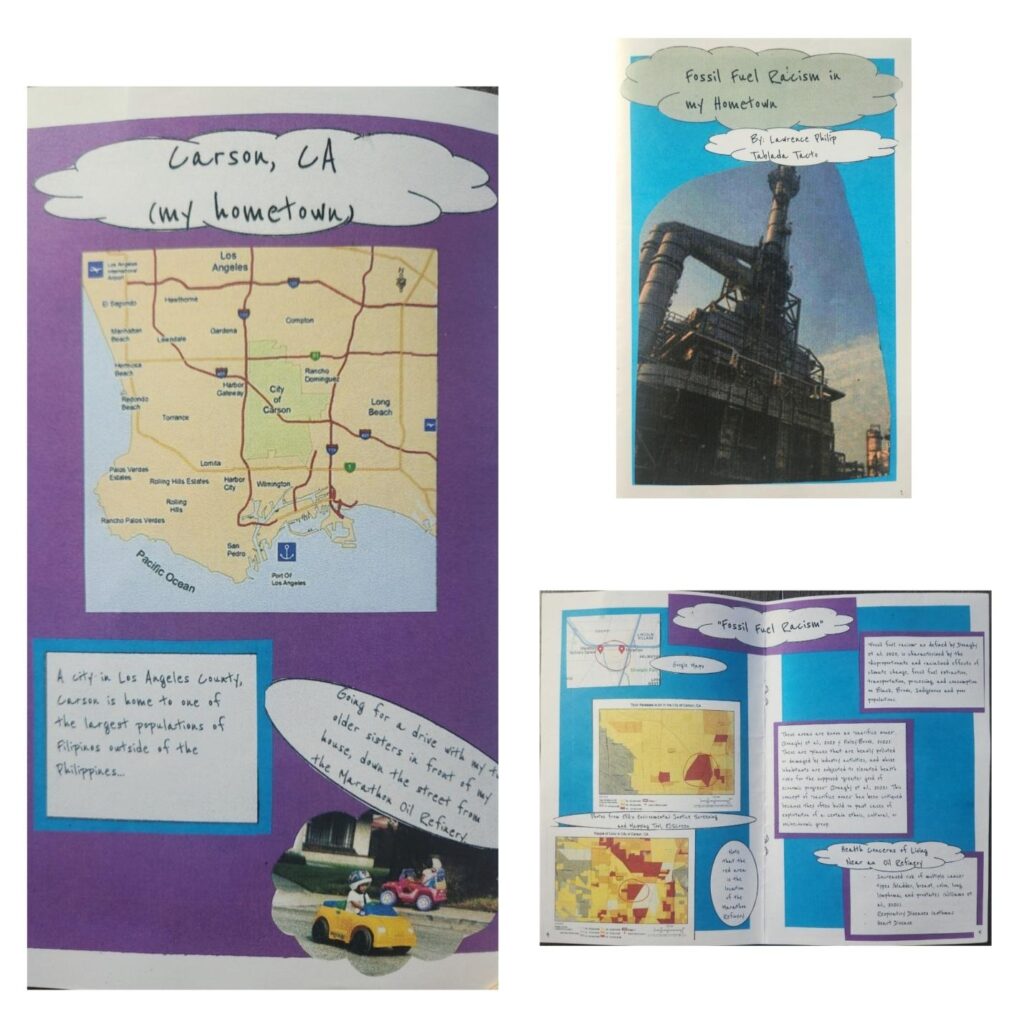
Growing up in Carson, California, I never noticed the effects the Marathon Oil Refinery had on the public’s health. To me, the refinery was a normal part of my life. It was just the large facility with bright lights that my family passed on the street. As a child, at night, I marvelled at the flames it periodically spewed, never considering the harm it was doing to my hometown. This changed in 2020, when the Marathon oil refinery experienced a large fire, followed by an earthquake that released toxic fumes in 2021, making the citizens of Carson ill with respiratory issues. It took the occurrence of two large-scale incidents in my late-teenage years to ask myself, “why my hometown?” As a Filipino-American, I grew up with many other kids like me. Nearly every kid at my school was of Filipino descent. In fact, Carson is home to one of the largest populations of Filipinos outside of the Philippines. It was this fact that made me wonder if the placement of the oil refinery was somehow connected to the large people of color (POC) population of Carson. This led me to the concept of ‘fossil fuel racism’ which is characterized by the ‘disproportionate and racialized effects of climate change, fossil fuel extraction, transportation, processing, and consumption on Black, Brown, Indigenous, and poor populations’ (Donaghy et al. 2023).
I used the zine assignment as an opportunity to research fossil fuel racism and specifically the placement of fossil fuel sites in POC communities with hopes that the people of Carson could connect with, and learn from, other cities that have experienced similar injustices (such as Richmond, California). Because of the low barrier-to-entry, zines are a great medium for communication. They allow any person to communicate what they want, with whom they want, in any way they want. I used personal photos, maps, and even a city flyer promoting Philippine Independence Day to not only inform Filipino Carson residents about the linkages between oil refinery sitings and fossil fuel racism, but to also celebrate our collective resilience against it. My suggestion for future zine-makers is to make the central idea behind your zine personal. That choice simultaneously gave me a profound appreciation for my city and the resilience of local Filipinos who migrated to Carson generations ago. It is a resilience we maintain to this day.
As a Pacific Islander from Hawaii, I am keenly aware of how Hawaiians face disproportionate rates of food insecurity, housing insecurity, and hazardous living conditions. My zine is part of a larger project entitled, The Environmental Marginalization of Native Hawaiians and other Pacific Islanders in Hawaii, which traces how colonial and neo-colonial forces disrupted connections to land as well as traditional food gathering practices of Native Hawaiians. Historically, Native Hawaiians were not unhealthy people—although racial stereotypes say otherwise. Sustainable food systems and diets were present in Hawaii up until colonization in the late 1700s. Native Hawaiians lived on Ahupua’a, or land divisions, that centered on sustainable methods of farming and promoted healthy diets including foods such as seafood, pork, sweet potatoes, breadfruit, and other fruits and vegetables (Smith 2019). The longstanding effects of colonialism on Native food systems is still felt today. Many Native Hawaiians as well as Pacific Islanders more broadly continue to suffer from lack of access to food or proper nutrition. 22% percent of Hawaii residents are food insecure, with Native Hawaiians positioned above this at 27%. Other Pacific Islanders make up a great number which is 44% (Stupplebeen, n.d.). Even when these groups have access to food, it is not usually healthy. As one Hawaiian doctor explained, ‘Healthy food [in Hawaii] is either too expensive, too far away for people who rely on public transit, or it takes too long to prepare for people who work multiple jobs. Instead of fresh produce… meals served in Hawaii’s low-income households typically consist of white rice with canned meat’ (as quoted in Friedheim, 2017). Inaccessibility to fresh produce has caused Native Hawaiians and other Pacific Islanders to develop poor diets, thus causing them to have higher rates of obesity and diabetes when compared to the average American (U.S. Department of Health and Human Services, 2017).
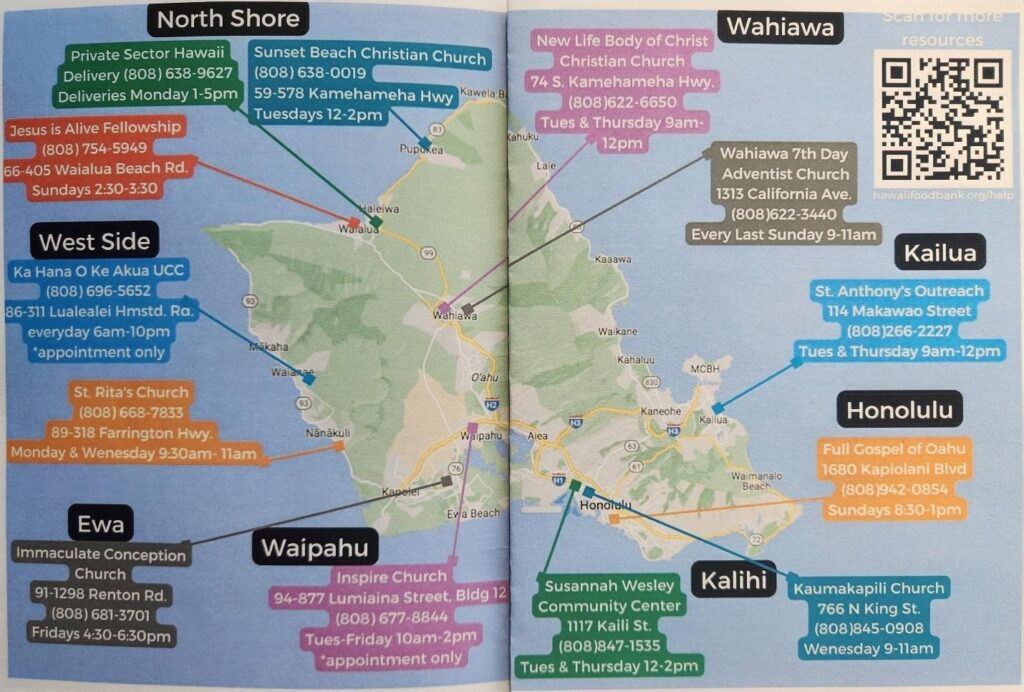
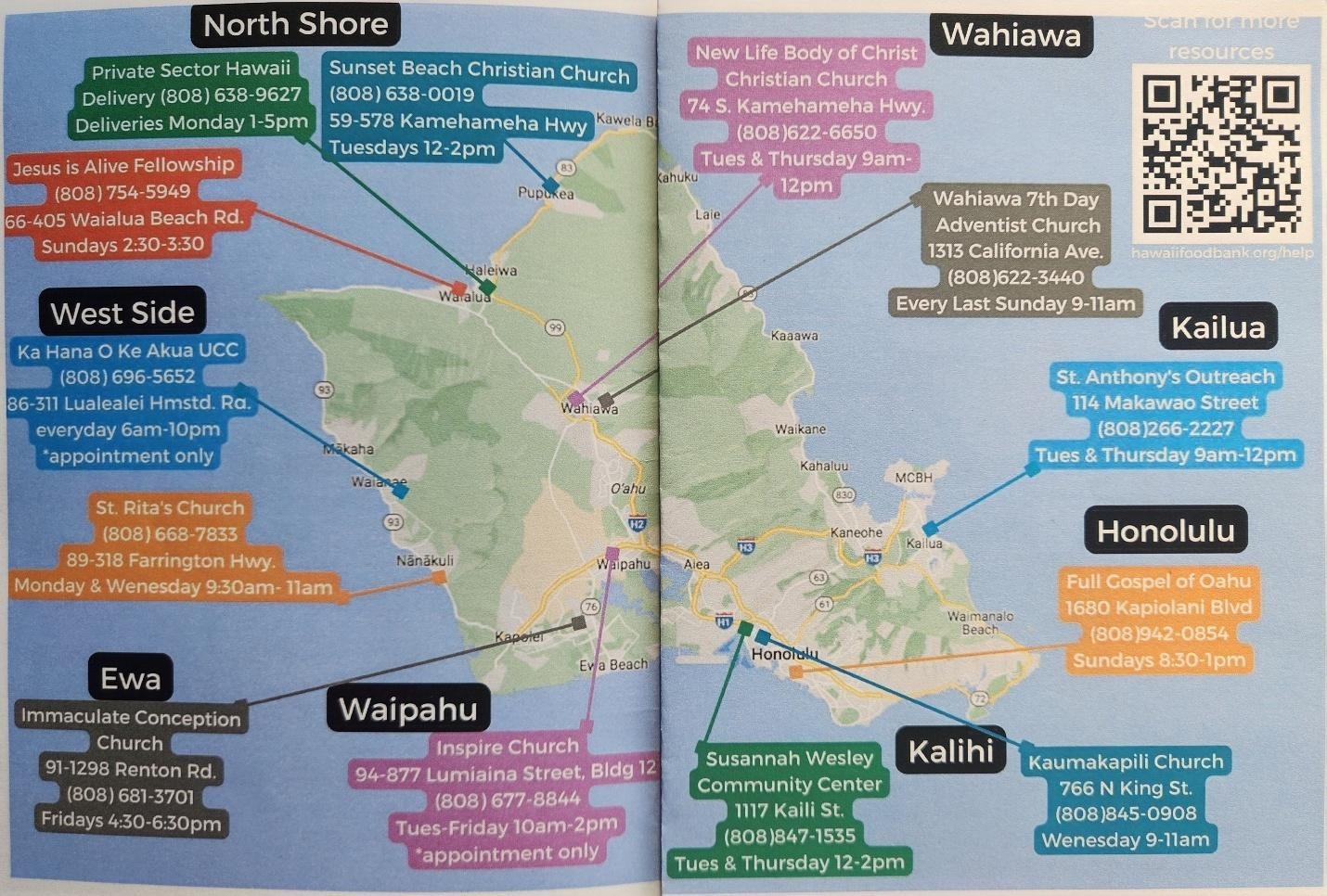
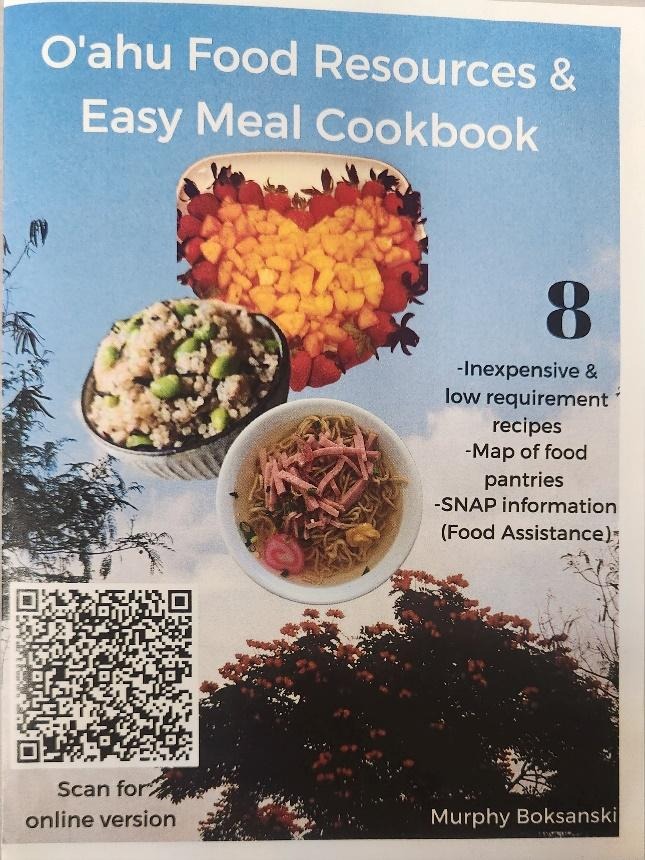
To help combat issues of food insecurity and poor nutrition – issues I have seen affect my own community and family members – I created the zine entitled O’ahu Food Resources & Easy Meal Cookbook. It includes 8 inexpensive and low requirement recipes. It also includes a map of food pantries located on the island of O’ahu and SNAP information. This zine is intended for both Pacific Islanders facing issues of food insecurity and anyone else who is has an interest in these issues. I have made great efforts to disseminate my zine. I shared my zine at the 2022 University of San Francisco’s (USF) zine fest which connected me to Bay Area zine libraries. Several libraries added my zine to their collections. As for Hawaii, hardcopies of my zine were handed out to community members facing these issues. I produced a digital version of my zine and shared it across O’ahu by creating a QR code for download. Zines are a great medium to communicate my research because this format helped me reach two critical audiences: those who were unaware of these issues, and those who are directly impacted by them in Hawaii.
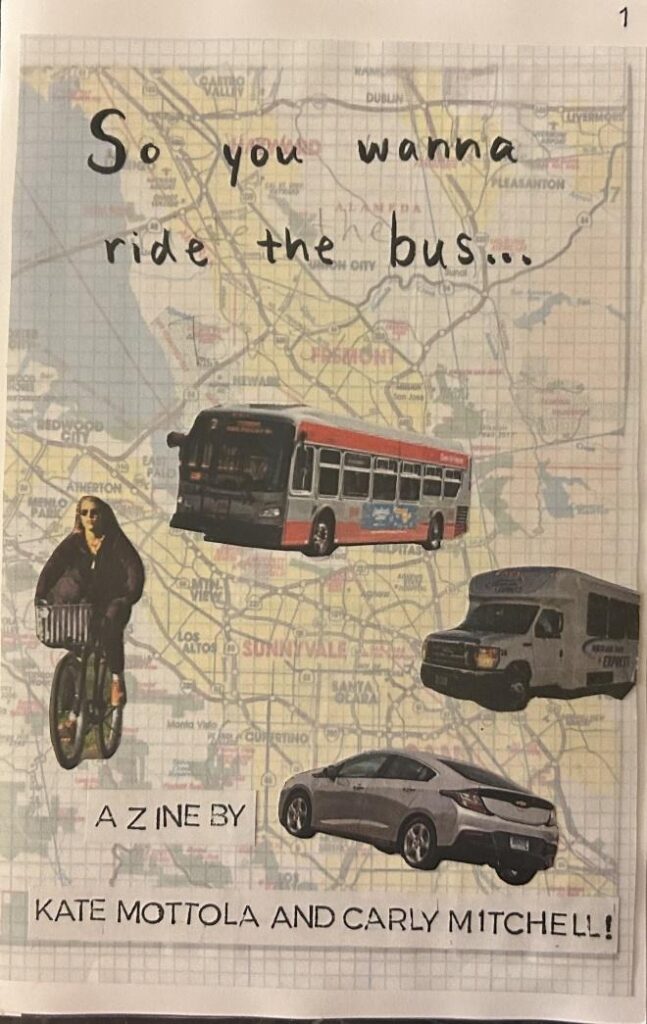
Our environmental justice zine focuses on the topic of transportation in the Bay Area. Since we both grew up in different parts of the Bay Area, we found it interesting to analyze the differences in transportation we used and our relationships to it, given our longstanding connections. We wanted to combine our personal experiences with city data and external studies of our transportation systems to understand issues of accessibility and environmental impact throughout the Bay Area. We came to this issue by initially looking at transportation in the contexts of food deserts, pollution, and access to green space; ultimately, we settled on the topic of green space and accessibility factors.
The current uneven distribution and maintenance of transit systems in the Bay Area creates barriers of access for people in low-income areas. When our so-called ‘public transportation’ system does not serve the whole public, a more integrated approach is needed. The purpose of our zine is to encourage the building and prioritization of green spaces for communities that do not have access. We wanted our zine to focus on the possible improvements that can be made in future legislation by emphasizing the benefits of visiting urban parks juxtaposed with the difficulty of visiting Bay Area parks without having access to a car. We looked at the mental and physical health benefits, as well as the distribution of socio-economic markers surrounding parks to show how important they are. We made several maps using the Environmental Protection Agency’s Environmental Justice Screen and Mapping Tool to visually depict the many socio-environmental barriers facing marginalized communities in addition to outdoor accessibility, including affordable healthcare, education, and housing.
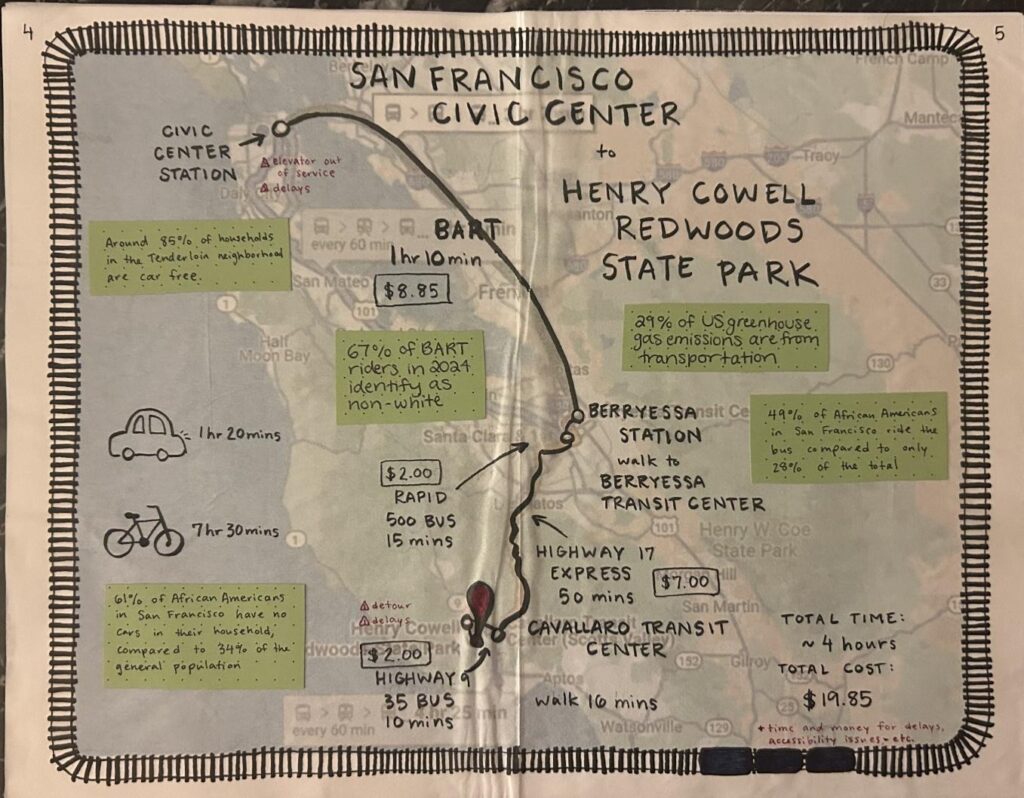
Despite the issues in the Bay Area around green space access, we wanted to make sure to highlight the recent transformative work that has been done in places like the Tenderloin neighborhood in San Francisco. The Tenderloin National Forest is a small park created in an abandoned lot that has become a community center in the neighborhood. By involving community members in the creation and upkeep of the park, this park is a model for adding parks without exacerbating gentrification.
The biggest challenge we had in creating the zine was determining how to illustrate the path we wanted to take our readers on, from our fragmented transportation network, to evidence of the need for green space, to a potential path forward. By collaborating with our peers and mentors in the classroom and USF zine library, we were able to come up with a way to follow our own thought path, from identifying a huge problem to being part of the solution.
My zine, Land and Labor, portrays the untold stories of emblematic landscapes in the United States, including national parks, agricultural fields, and the historical and modern plantation. This approach was inspired by a class discussion about the absence of humans in many famous works of art portraying landscapes, and how this is representative of the longstanding human/nature dualism present in American culture. In my zine, I sought to understand how this dualism shapes racialized landscapes to illuminate how these landscapes are intertwined with stories of both oppression and resilience. An influential text we read in class was Cronon’s (1996) The Trouble with Wilderness, which examines ‘nature’ as a human construct – one that is shaped through violence and injustice particularly towards Indigenous peoples in the formation of National Parks. Cronon’s major argument – likely familiar to many political ecologists – is that physical landscapes are reflections of human culture, and different social groups may experience even the most ‘natural’ landscapes in vastly different ways. Another influential scholar, Mitchell (1996), discusses this concept in the context of agriculture. In The Beautiful and the Damned, Mitchell examines the parasitic relationship between California’s expansive agricultural landscape and the migrant worker population who tend to it. While the exploitation of migrant farm workers in California is a terrible reality, the designation of the whole group as “damned” lacks nuance and fails to share agricultural workers’ personhood beyond their work.
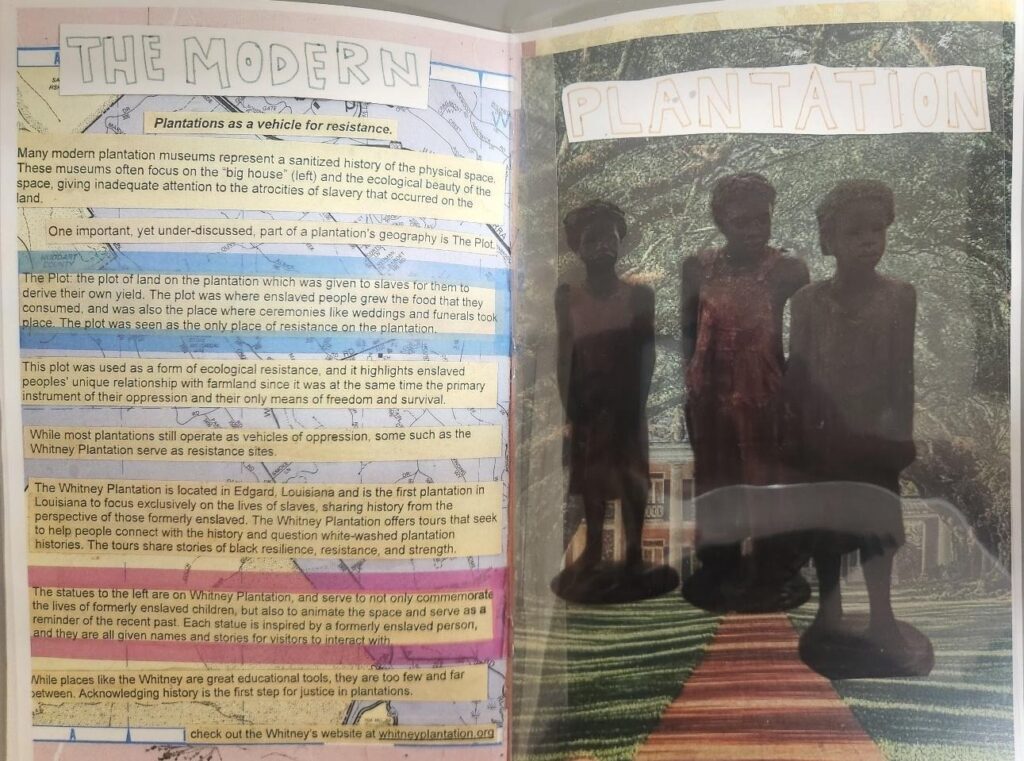
Telling the story of resistance and resilience in the creation of landscapes is extremely important and is the reason why the work of scholars working on Black Ecologies of resistance resonated with me. Black Ecologies and plantation geographies discusses the physical structure of both the historical and modern-day plantation, and how land continually and simultaneously acts as an instrument of oppression and of resistance (Roane, 2021). ‘The Plot’ was part of the antebellum era plantation, which was a piece of land given to enslaved peoples on plantations and was the only piece of land over which they had complete control. This land was used for personal food cultivation, and for ceremonies like weddings and burials, and is a significant landmark on the plantation when examining it from the perspective of the enslaved (Roane 2021). Unfortunately, the perspective of the enslaved is something which is rarely highlighted on modern plantation spaces, many of which are now used as event venues, museums, and prisons (Levin 2012; Whitney Plantation 2024; McDowell, Mason, 2024). Plantations as event-spaces and places of joy are oblivious to, and dismissive of, history. Modern plantation museums are often not much better. Many of them focus solely on white culture and opulence in the antebellum period and lack any information about the culture and reality of the enslaved (Levin, 2012). In this way, many modern plantation museums continue to profit off the exploitation of the enslaved, which speaks to the permanence of racialized landscapes and embedded power structures. Fortunately, there are exceptions. The non-profit and Black-owned Whitney Plantation uses sculpture and other art forms to tell the story of the plantation from the point of view of the enslaved (Whitney Plantation, 2024).
My zine features an image from The Whitney’s website which is a sculpture of a formerly enslaved child printed on clear plastic paper . The zine is bound in a way where, on the right, there is an image of the ‘big house.’ On the left, there is an informational page, and in the middle there is the clear plastic page, with the image of the sculpture printed on it. The idea is that you can flip the clear page over the image of the plantation and see the image both with and without the sculpture of the child. This method was used to spur reflection on how the presence of humans in an image changes our perception of the landscape, and to remind us of the role of humans in the creation of landscapes. It is also a reminder of the brutal history of many landscapes, and the importance of talking about them. I chose this medium because I knew that I wanted my zine to be tactile and interactive, which is also why I used the collage technique. Many of my collage materials came from old magazines and the internet. However, I encountered an interesting tension. In my zine-making process, I found an image on the website of an Indigenous tribe in my area that I wanted to use, and I emailed them asking permission. They kindly responded ‘no’, which made me think about the free-use nature of zines, and what that means in a representational context, particularly if we use unauthorized images or texts of marginalized groups. While I think zines are a great way to spread information, I also think it is important that fast and free communication does not come at the expense of cultural respect and autonomy. I believe that zines can be a very powerful tool for education, which is why I believe academic citations and permission from marginalized groups should be considered when discussing ethically or culturally sensitive information.
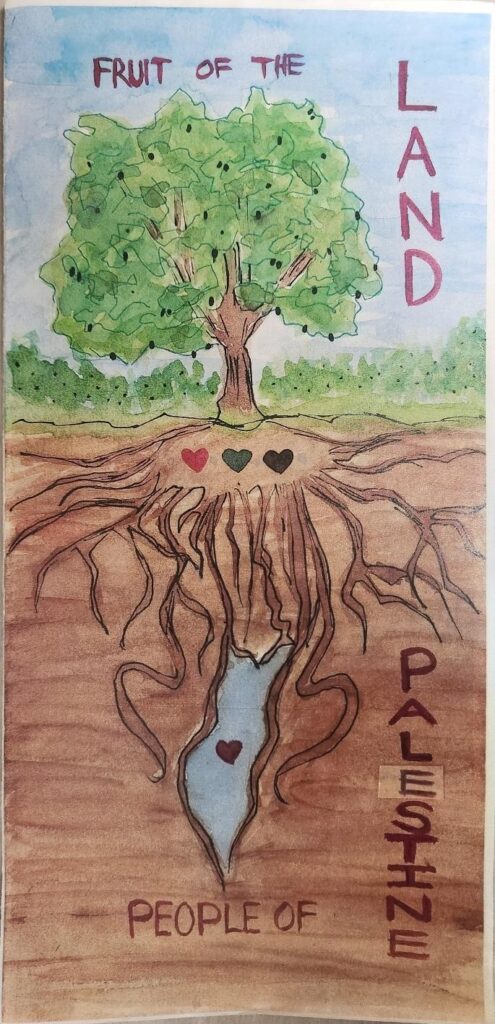
My zine is entitled, Fruit of the Land: People of Palestine. I wanted it to reflect the deep connection Palestinian people have to their land, using frameworks and themes from environmental justice. To portray Palestine’s long and rich history, I examined significant symbols related to Palestinian culture as forms of powerful resistance. The cover depicts a hand painted watercolor olive tree. Its roots extend far into the earth, creating an outline of Palestine. Olive trees, which symbolize identity and strength, represent the Palestinian people. The roots also reflect how people come from, and rely on, the earth. This dynamic connection has been violated for decades in Palestine. To explore Palestine’s rich culture in my zine, I included traditional recipes, poetry, cultural symbols of resistance, and local protest photos (from @the_owl_parrot on Instagram). I wanted my zine to focus on more than historical facts and statistics, elaborating on artistic and cultural aspects. It is important to keep monitoring current events and reporting ongoing violence, but there’s a risk when people on the receiving end of this violence are only understood in terms of their suffering. I wanted the cultural and artistic pieces of the zine to move beyond this and to highlight another side to the subject. With oppression and erasure, there is always resistance and resilience. Zines are a very powerful method of environmental communication since there is a lot of freedom and creativity involved in making them. They translate complex science and justice concepts into language, images, texts more appropriate for lay audiences, especially local communities. It is crucial to deliver information to the public in ways that engage them, and zines do this in unique and more personal ways.
Arribathi, A. H., Suwarto, Miftakhu Rosyad, A., Budiarto, M., Supriyanti, D., & Mulyati, F. (2021). An analysis of student learning anxiety during the COVID-19 pandemic: A study in higher education. The Journal of Continuing Higher Education, 69(3), 192-205.
Bagelman, C. C., and Bagelman, J. (2016). Zines: Crafting change and repurposing the neoliberal university. Acme, 15(2), 365-392.
Bouzarovski, S. (2022). Just transitions: A political ecology critique. Antipode, 54(4), 1003-1020.
Cronon, W. (1996). The Trouble with Wilderness: Or Getting Back to the Wrong Nature. Forest History Society, American Society for Environmental History. https://www.jstor.org/stable/3985059
Donaghy, T. Q., Healy, N., Jiang, C. Y., & Battle, C. P. (2023). Fossil fuel racism in the United States: How phasing out coal, oil, and gas can protect communities. Energy Research & Social Science, 100, 103104.
Finney, C. (2014). Black faces, white spaces: Reimagining the relationship of African Americans to the great outdoors. UNC Press Books.
Friedheim, N. (March 2017). Why It’s So Hard To Eat Healthy In Hawaii If You’re Poor. Honolulu, Hawaii: Honolulu Civil Beat. https://www.civilbeat.org/2017/03/why-its-so-hard-to-eat-healthy-in-hawaii-if-youre-poo r/
Guzzetti, B. J., & Gamboa, M. (2004). Zines for social justice: Adolescent girls writing on their own. Reading research quarterly, 39(4), 408-436.
Hawkins, H. (2013). Geography and art. An expanding field: Site, the body and practice. Progress in human geography, 37(1), 52-71.
Hecht, S. B., & Cockburn, A. (2010). The fate of the forest: developers, destroyers, and defenders of the Amazon. University of Chicago Press.
hooks, bell. (2014[1994]). Teaching to transgress. Routledge.
Kenney-Lazar, M., Johnson, A., Sultana, F., Himley, M., Bebbington, A., Havice, E., … & Osborne, T. (2023). Relational environmental governance: A critical framework for praxis with the material world. Journal of Political Ecology, 30, 678.
Knight, R. (2018). How zine libraries are highlighting marginalized voices. BuzzFeed. December 30. Retrieved from: https://www.buzzfeednews.com/article/rosieoknight/zines-libraries-marginalized-voices
Lakhani, N. and Watts, J. (2020). Environmental justice means racial justice, activists say. The Guardian. June 18. Retrieved from: https://www.theguardian.com/environment/2020/jun/18/environmental-justice-means-racial-justice-say-activists
Levin, Cherry-Lynn. (2012) Wedding Belles and Enslaved Brides: Louisiana Plantation Weddings in Fact, Fiction and Folklore. ProQuest. https://www.proquest.com/docview/2674895761/fulltextPDF/7CF07B1A4969496EPQ/1?accountid=14674&sourcetype=Dissertations%20&%20Theses
Mitchell, D. (1996). The Lie of the Land: Migrant workers and the California landscape. University of Minnesota Press.
McDowell, R. and Mason, M. (2024) Prisoners in the US are part of a hidden workforce linked to hundreds of popular food brands. The Associated Press. Retrieved from: https://apnews.com/article/prison-to-plate-inmate-labor-investigation-c6f0eb4747963283316e494eadf08c4e
Pokhrel, S., & Chhetri, R. (2021). A literature review on impact of COVID-19 pandemic on teaching and learning. Higher education for the future, 8(1), 133-141.
Roane, JT. and Dunning, S. (2021.) Black Ecologies with Professor JT Roane. [Audio Podcast Episode] In Black To Nature. June 10. Retrieved from: https://www.audacy.com/podcast/black-to-nature-48e89/episodes/black-ecologies-with-professor-jt-roane-e52cd
Scheper, J. (2023). Zine pedagogies: students are critical makers. Radical Teacher. 125 (Spring), 20-32.
Smith, L., Cartwright, C., Brennan-Lister, G., Brooks, E., Collins, F., Colson, S., … & Munnery, C. (2024). Zine Ecologies: Creative Environmentalisms and Literary Activisms. GeoHumanities, 1-24.
Smith, T. (2019). History, “Unwritten Literature,” and U.S. Colonialism in Hawai’i, 1898–1915. Diplomatic History, 43(5), 813–839. https://doi.org/10.1093/dh/dhz038
Sou, G. (2023). Wiley Lecture 2022. Communicating climate change with comics: Life beyond apocalyptic imaginaries. Geographical Research, 61(3), 320-332.
Sou, G., & Hall, S. M. (2023). Comics and zines for creative research impact: ethics, politics and praxis in geographical research. ACME, 22(1), 817-841.
Tolia-Kelly, D. P. (2012). The geographies of cultural geography II: Visual culture. Progress in Human Geography, 36(1), 135-142.
Tuck, E. (2009). Suspending damage: A letter to communities. Harvard educational review, 79(3), 409-428.
Turner, M. D. (2017). Political ecology III: The commons and commoning. Progress in Human Geography, 41(6), 795-802.
U.S. Department of Health and Human Services. (July 2017). Health Conditions and Behaviors
of Native Hawaiian and Pacific Islander Persons in the United States, 2014. Hyattsville,
Maryland. https://www.cdc.gov/nchs/data/series/sr_03/sr03_040.pdf
Velasco, G., Faria, C., & Walenta, J. (2020). Imagining environmental justice “Across the street”: Zine-making as creative feminist geographic method. GeoHumanities, 6(2), 347-370.
Walker, P. A. (2007). Political ecology: where is the politics?. Progress in Human geography, 31(3), 363-369.
Whitney Plantation, The (2024). About. whitneyplantation.org. Retrieved from: https://whitneyplantation.org/history/
22 / July / 2026
By: Gerónimo Barrera de la Torre y Carlo Nasisse
22 / July / 2026
By: Adrienne Johnson, Murphy Boksanski, Nicolette Mehdizadeh, Carly Mitchell, Katherine Mottola, Lawrence Philip Tablada Tacto, Isabella Well
22 / July / 2026
By: Emma Johansson
22 / July / 2026
By: Asamblea Socioambiental Huinganco con Adriana Arce, Maximiliano Navarrete y Mattias Borg Rasmussen
22 / July / 2026
By: Aung Htun Lin & Sofie Mortensen