By: Emma Johansson
22 / July / 2026
Over the past decade, I have used participatory visual methods to explore socio‑environmental change in contexts of land conflict and struggles for more sustainable and just food systems. Working with a Tanzanian artist, I have co‑created paintings that engaged farmers and pastoralists to varying degrees: sometimes participants held the brush painted with us, sometimes they directed the artists what should be depicted and later “peer‑reviewed” the process. These paintings have served multiple communication functions—enabling farmers and pastoralists to express their visions to other food‑system actors, appearing in exhibitions and conferences, and offering something tangible back to participating communities.
My motivation for using participatory art has been twofold: to learn from and include the perspectives of people facing land dispossession and conflict, and to communicate their everyday struggles and future aspirations to audiences both within and beyond academia. Sharing smallholders’ experiences with more powerful actors is one attempt to challenge entrenched inequalities in food systems. Yet the ambition to spur change through co‑created artworks is difficult—not least because following up on impacts requires time and resources that researchers rarely have. In this short essay, I reflect on two experiences of co‑creating and disseminating participatory paintings, and on the types of impacts they may have generated.
It all started in an alley in Dar Es Salaam, 13 years ago, where I met the Tanzanian artist Lyombo who taught me how to paint tinga-tinga paintings. Together we made a painting that portrayed my own perceptions of how people and the environment were impacted by a Swedish large-scale sugarcane plantation outside of Bagamoyo. Back in Sweden, I noticed that people who came by my office often wanted to talk about the painting on my wall, but I always had to say that “it’s just my imaginary view of how people in Tanzania are affected by land grabbing”. I started to think about how people who are actually affected by land grabbing would describe how their lives and landscapes have changed, and what futures they desired. So, I went back to Tanzania to paint paintings with farmers, fishermen, and pastoralists, with the help of my artist friend Lyombo.
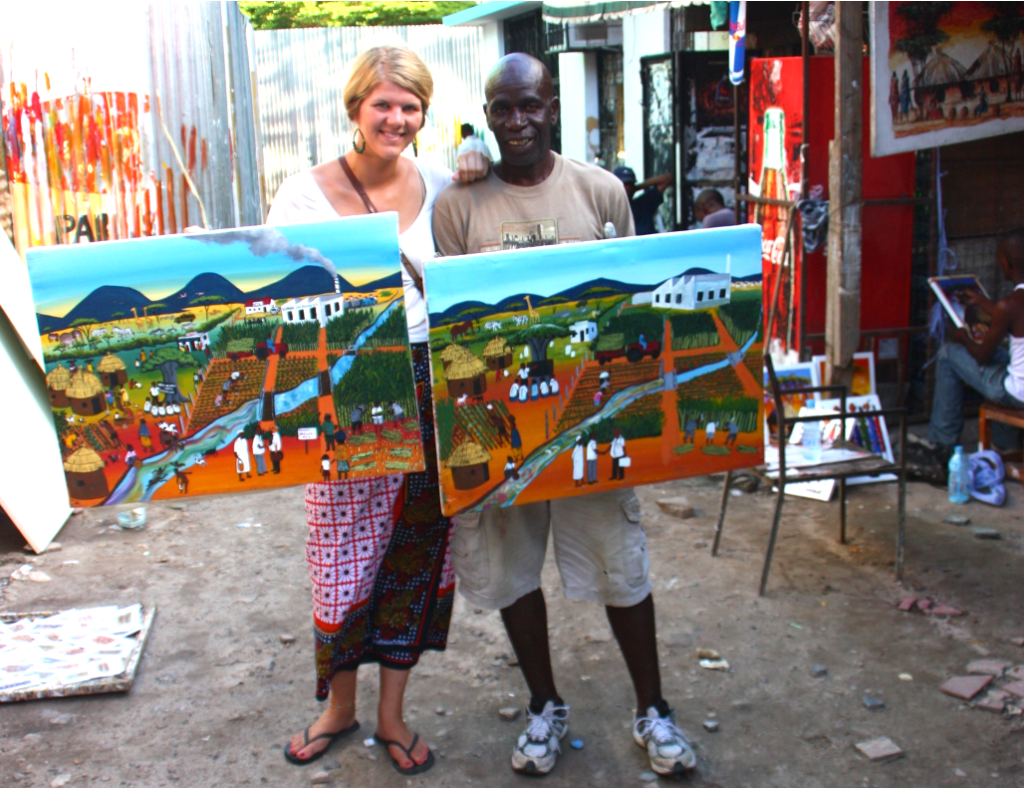
Me and Lyombo in Dar Es Salaam in 2013, and the tinga-tinga painting he taught me to make.
Two paintings created with residents of Mkangawalo illustrate how they perceived landscape transformation after Kilombero Plantation Ltd. (a British company at the time) began cultivating rice on 5,818 hectares. Participants described the disappearance of forests, water sources, fish, and wildlife—not always as direct impacts of the plantation, but also indirect effects as population pressure pushed farmers into new areas. They also emphasized the health hazards posed by chemicals spread by airplane.
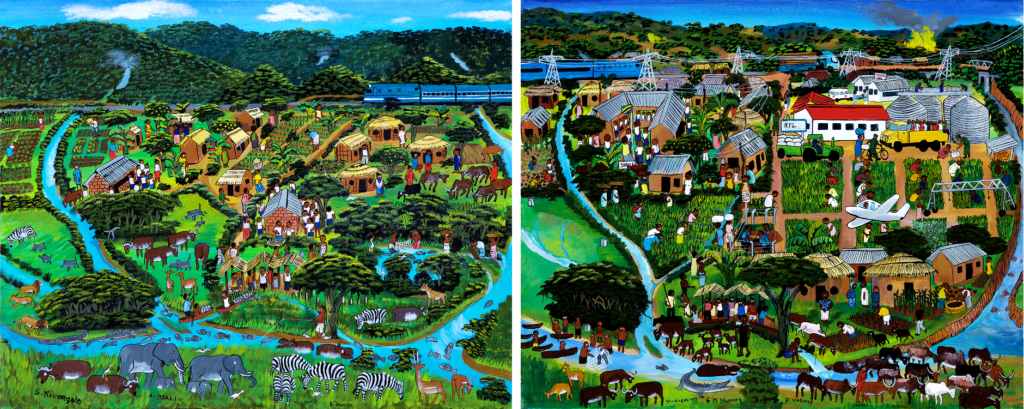
Paintings made by farmers, pastoralists and fisherfolk in Mkangawalo, Kilombero Valley through instructions from Lyombo. The painting to the left describes the past (just before the arrival of KPL), and the painting to the right describes the current situation (in 2015).
Exhibiting these paintings at the National Museum of Tanzania made me aware of the power of combining art and research. Both me and the museum staff were threatened by the government, and were forced to censor our speeches, information texts and parts of the paintings. We were no longer allowed to say anything about foreign investors, land acquisitions, or mention company or village names. Even without words, visitors understood the message.
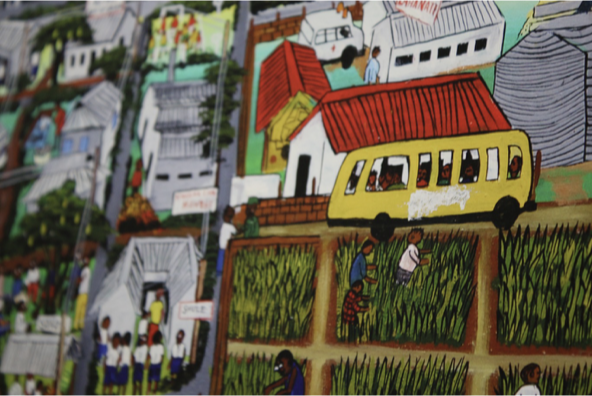
Prints of the paintings had to be censored for the exhibition at the National Museum and House of Culture in Dar Es Salaam in 2016. Company names were covered in white paint.
The paintings have also served as a way to share research results with participants. A painting is undeniably more engaging than an academic article. Each time I returned with prints, community members emphasized that “no researcher has ever come back to share their results.” Even if this might not be life changing for anyone, a token of appreciation can help build better relationships between researchers and participants through a sense of shared ownership of the material that was co-created. Just as I use the paintings for communicating my research, they can also be used by the participants in any way that they wish. Some communities displayed the prints in their village offices, using them to communicate local challenges to visitors—including NGOs and other researchers.
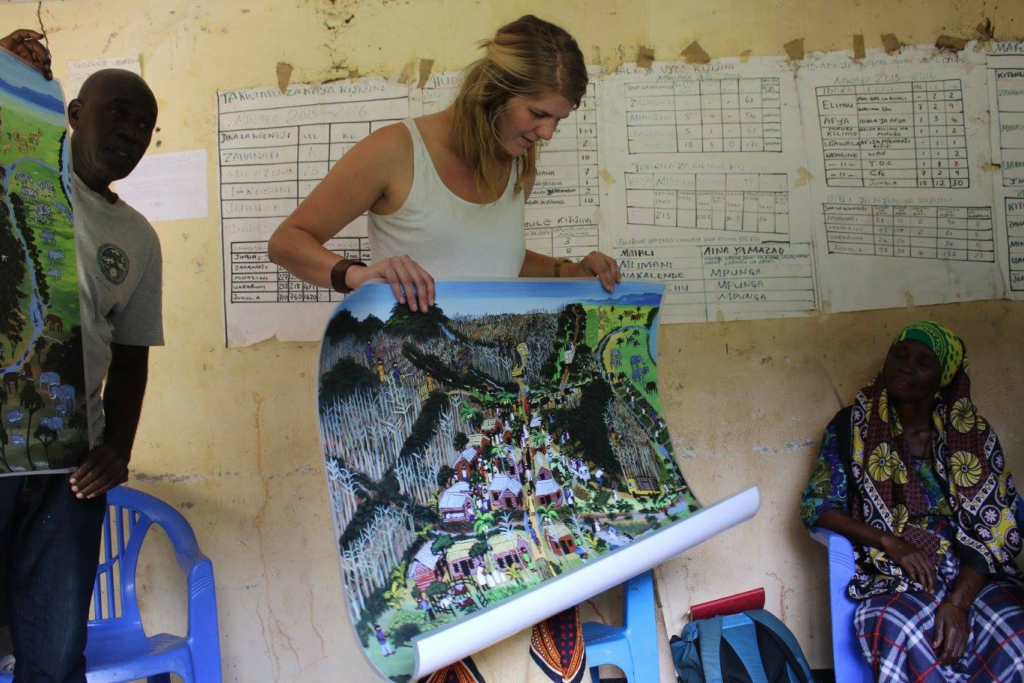
Giving back prints to one of the participating communities in Nakafulu, Kilombero Valley.
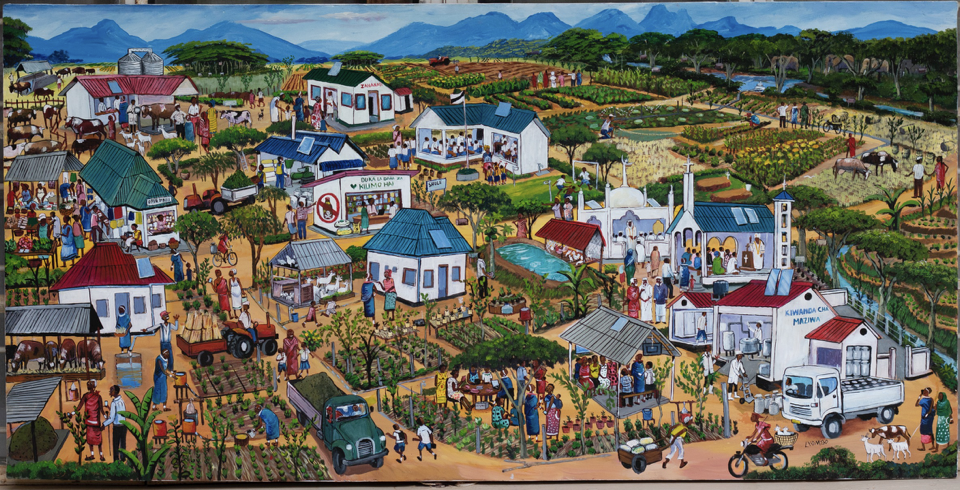
I have also applied participatory art in research on sustainable futures, co‑creating visions with farmers and pastoralists who are often in conflict over land and natural resources. In these visions, they describe cooperation through agroecology and sustainable livestock keeping, drawing on programs offered by the NGO Sustainable Agriculture Tanzania. Working with “forerunners” already practicing their desired futures allowed us to ground the visions in lived experience and to discuss with other actors how such initiatives might grow. As a researcher, I can provide a platform to co-create knowledge about hopeful futures, together with people who otherwise have very little power over their situation and the world around them.
Future vision of an agroecological food system where farmers and pastoralists live together in peace and collaboration.
One of the most meaningful outcomes was seeing a pastoralist who cannot read or write use the illustration to explain his future vision during a workshop at Sokoine University of Agriculture. These visual narratives helped bring rarely heard voices into debates on sustainable agriculture. Participants collectively developed action points to support the envisioned futures, though the difficulty of ensuring follow‑up actions—and the structural constraints of politics and power—remains ever-present. Still, such challenges do not diminish the importance of amplifying marginalized perspectives.
In my more recent work in Mvomero District, Tanzania, follow‑up has been challenging. Communication with the NGO involved has been difficult to maintain, and they have not informed me about their use of the paintings. During a revisit, none of the communities had displayed the prints, though they valued receiving them. Because participants came from multiple villages, coordinating where to place the prints was impractical. To increase accessibility and usefulness, we also produced pamphlets in Swahili describing the future visions.
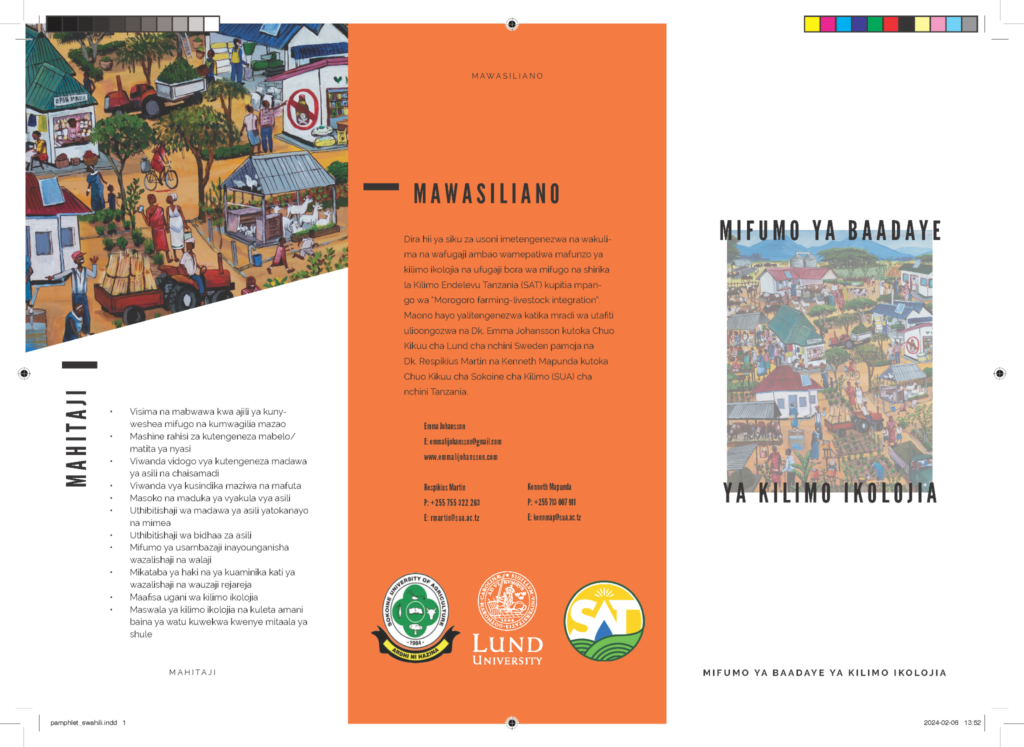
Part of a pamphlet in Swahili that was distributed at the sites where the illustrations of the future visions were received.
So, does co-creating and disseminating participatory future visions really matter? I believe it does. Even if the societal impacts of participatory art are difficult to quantify, the approach enables researchers to give something back—an ethical and relational outcome that should not be undervalued. I also know that:
Johansson, E., Martin, R., & Mapunda, K. M. 2023. “Participatory future visions of collaborative agroecological farmer-pastoralist systems in Tanzania”. Agroecology and Sustainable Food Systems, 1-31.
Johansson, E. L., Brogaard, S., & Brodin, L. 2022. “Envisioning sustainable carbon sequestration in Swedish farmland“. Environmental Science & Policy, 135(16-25).
Johansson, E. 2021. “Participatory futures thinking in the African context of sustainability challenges and socio-environmental change.” Ecology and Society, 26(4):3.
Johansson, E., and E. Isgren. 2017. “Local perceptions of land-use change: using participatory art to reveal direct and indirect socioenvironmental effects of land acquisitions in Kilombero Valley, Tanzania.” Ecology and Society, 22(1).
22 / July / 2026
By: Gerónimo Barrera de la Torre y Carlo Nasisse
22 / July / 2026
By: Adrienne Johnson, Murphy Boksanski, Nicolette Mehdizadeh, Carly Mitchell, Katherine Mottola, Lawrence Philip Tablada Tacto, Isabella Well
22 / July / 2026
By: Emma Johansson
22 / July / 2026
By: Asamblea Socioambiental Huinganco con Adriana Arce, Maximiliano Navarrete y Mattias Borg Rasmussen
22 / July / 2026
By: Aung Htun Lin & Sofie Mortensen