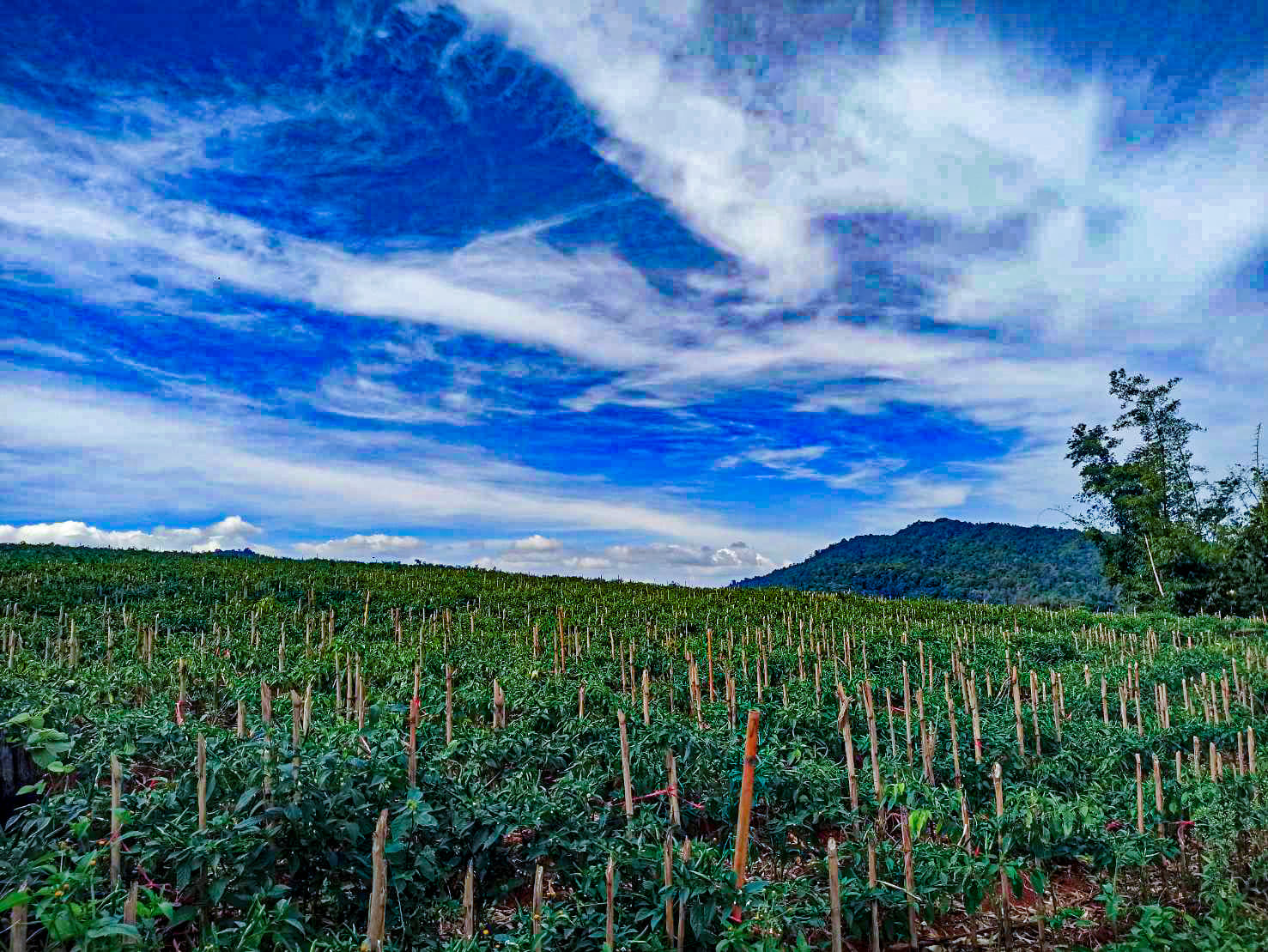
By: Mi Mi (Myanmar farmer); JC (independent illustrator); Hilary Faxon (University of Montana), Zin Mar Pyo (Chiang Mai University) & Jenny Hedström (Swedish Defense University)
22 / July / 2026
Participatory visual methods as well as collaborations with artists can enhance political ecologists’ ability to know and communicate accounts of life on the land. This is particularly true in times and places where traditional research is impossible. Our project, Land, Labor, Love & Revolution, explores rural women’s perspectives of life on the land in the unfolding Myanmar Spring Revolution. While large cities and frontlines garnered significant media and scholarly attention after Myanmar’s 2021 military coup, little work to date has investigated the everyday dimensions of revolutionary life in rural Myanmar, where the majority of the country’s population relies on land-based livelihoods. Our project used a remote photovoice methodology to understand how new and renewed patterns of violence, displacement and resistance are disrupting and reworking agrarian life. Through collaborations with artists, we illustrated these accounts, seeking both to document everyday experience and enact a more emancipatory politics.
This work began on a hike, during a conversation between a political ecologist and a war studies scholar, both foreign feminists who had worked in Myanmar for over a decade, about the challenges and ethics of conducting research in a period of political violence. We turned to photovoice, conducted remotely, as a method to understand rural women’s lived experiences during this period, and invited long-term collaborator and Myanmar researcher Zin Mar Phyo to contribute her ideas and research skills. The result was a series of four photo-essays with women in different parts of Myanmar, work we shared in a journal article and a graphic novel. Throughout our collaboration, we sought to embrace different types of data. For our most recent academic article, we combined JC’s illustrations of Mi Mi’s story with oral histories and large-scale datasets of food insecurity and violence. Contextualizing Mi Mi’s story within visualisations of food insecurity and conflict mapping helped connect her account to emerging social and economic issues in the spheres of food and agricultural production. We have also fostered engaged and reflexive dialogue in this article about the ethics and imperatives of conducting research during political crisis and with survivors of violence as a collaboration that is generative and warm, but still structured by inequality in citizenship and professional status.
In this visual essay, we first introduce Mi Mi’s story, illustrated by JC. Next, we present short excerpts from a follow-up interview with Mi Mi and a reflection with JC, both conducted in 2024. Together, these provide some insights into the processes and practices of participatory visual methods in political ecology. In our case, photovoice, interviews, illustration, and reflections have been iterative processes, conducted over three years in a widening circle of collaborators. Images first helped us to understand the situation on the ground in a place cut off by war and frequent internet black-outs, as well as to how Mi Mi made sense of the physical changes in the landscape. Later, illustrations have been crucial for disseminating this work more widely, including within the Myanmar community in and outside the country.
28-year-old Mi Mi lives in Karenni State, in Eastern Myanmar. After the military coup on February 1 2021, her life changed. When there was fighting or shelling, they could not go to farm and had to pause work. She said “after the coup, farming did not work well. I could not do weeding after planting since there was fighting in my village. We had to run and couldn’t take care of our farm.” They could only produce about 4 bags of rice on their 2 acres of land (before it was about 90 bags). In 2022, her family had to leave their farm and village due to severe fighting. Her family moved several times, fleeing from place to place to avoid fighting. Eventually they had to flee to another place where her mother and sisters lived.
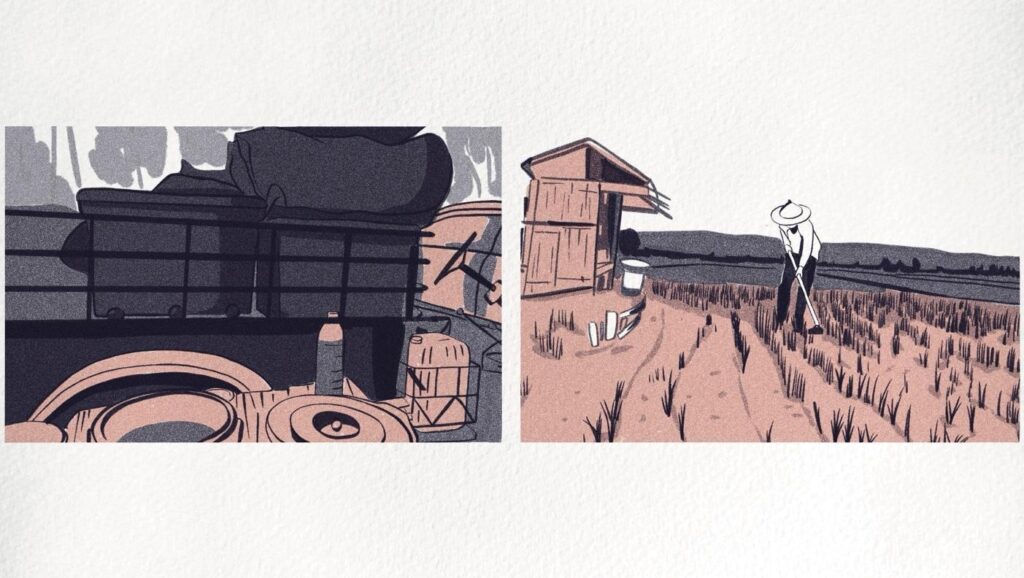
JC’s original illustrations depict Mi Mi’s photos, taken as part of her photoessay. On the left, Mi Mi shows how they carried their things and fled from place to place due to the fighting. She explained that she gathered all necessary things, collecting clothes and dishes, and kept it all organized, ready to go. Her husband packed heavy boxes in a small farm truck. She faced a lot of difficulties in preparing and packing before fleeing since she had recently given birth to her first child, and had to do all household chores with her baby on her back. Her husband also helped holding the baby. The baby could not sit or walk yet during that time. On the right, Mi Mi chose this photo to show the condition of her farming and how close the fighting is. The mountain area in her back side is where the fighting happens most of the time. The small hut is where she and her husband took a rest and had food during farming. She also took photos of her husband planting by spreading rice seeds. She selected this photo to show how they changed their farming practices due to the fighting, switching from transplanting seedlings to broadcasting seeds to save time and reduce risk. That image also included other people in the distance, friends from neighboring farms who were helping them, taking turns sharing labor on each others’ fields.
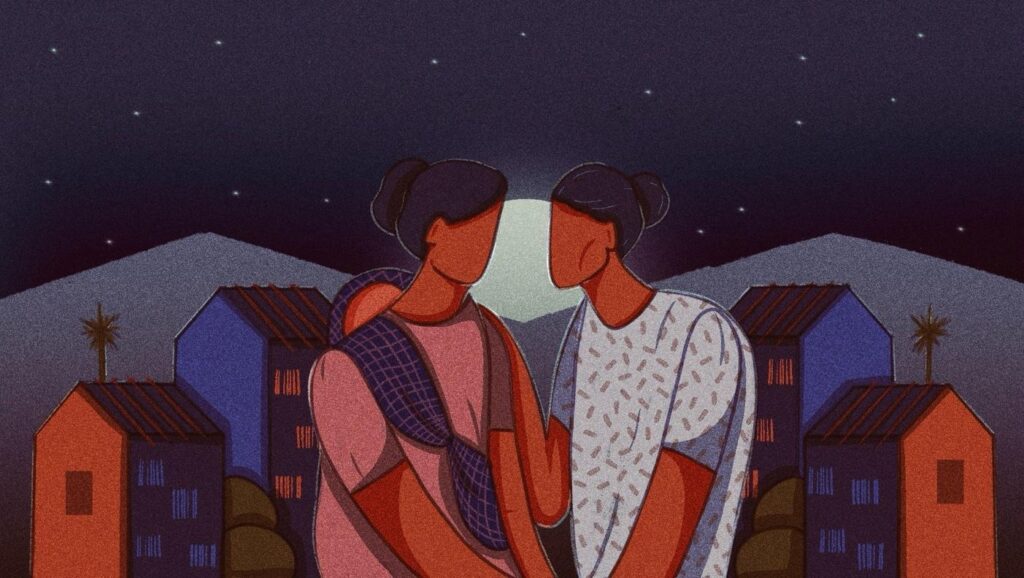
Initially, our work with illustrators was motivated by security concerns: we were worried that photos could be identifiable. But working with artists opened up new insights and avenues for collaboration. After initially asking JC to simply illustrate photographs, we later asked her to create novel illustrations from Mi Mi’s images and interviews. This image above, for example, depicts Mi Mi’s arrival to her mother’s village. Mi Mi told us: “I had to run 2 or 3 times from place to place. My mother told me if I had to die in the fighting, die here together with the family. So I ran to this village where my parents live.”
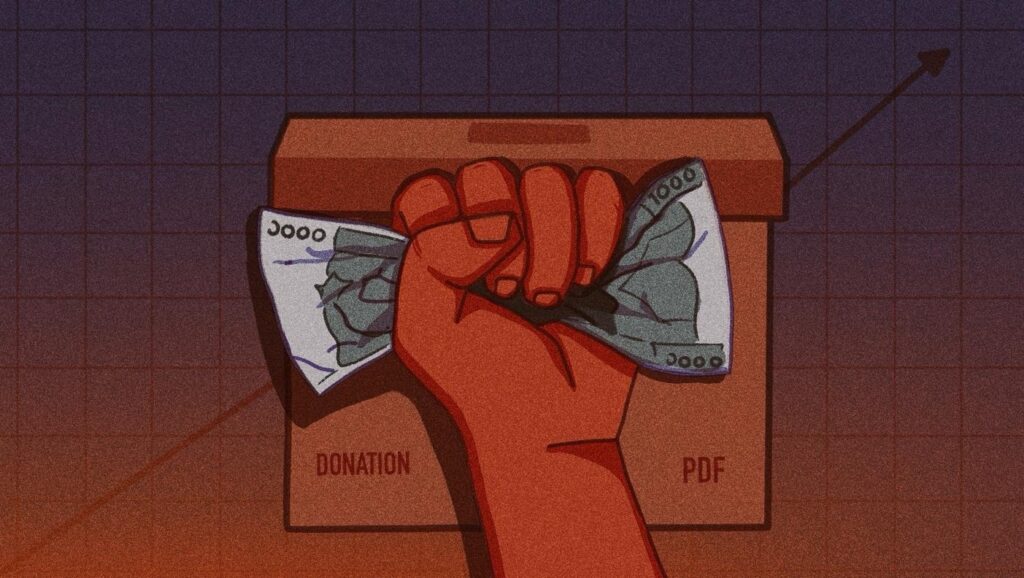
Despite the challenges of farming, cooking and caring for her baby, Mi Mi and her family continued to support the resistance against the military government. Since the military coup, Myanmar’s economy has suffered; while rich people continue to live well in major cities, middle and working class people in both urban and rural areas have been squeezed by worsening inflation and currency collapse. In 2022, Mi Mi explained that the commodity and oil price, fertilizer price and labour cost had already doubled or tripled; for example, 1 liter of petrol went up from 4,000 to 9,000 kyat and renting equipment to plow increased from 4,000 to 8,000 kyat per hour. Even as inflation and currency crisis pushed prices of daily necessities higher and higher, she donated money often to local People’s Defence Forces who were fighting the junta. The funds help them buy weapons, food, and supplies. In addition, her husband joined military training for a week given local resistance fighters, in order to be ready to join the revolution when it is necessary. Another illustration by JC depicts Mi Mi’s continued donation even amidst economic struggles wracking the country.
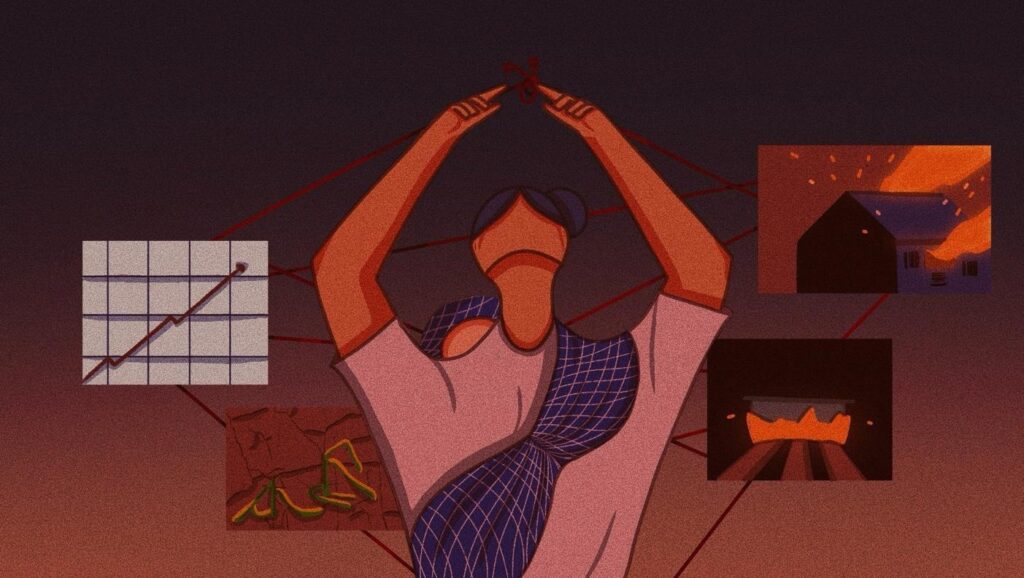
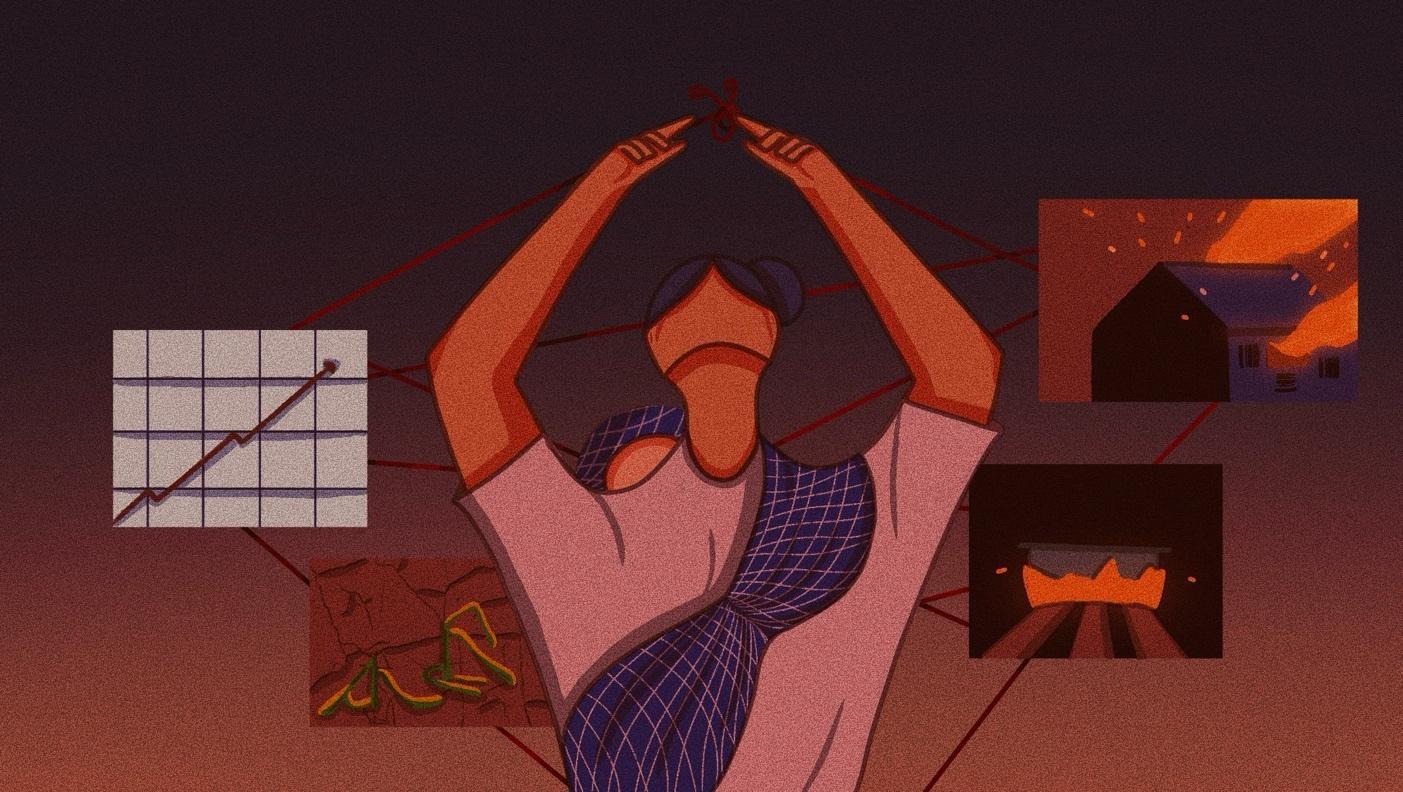
JC encapsulated Mi Mi’s story with the image above, which weaves together her accounts of drought, inflation, destruction, cooking, and caring for her baby. This composite image conveys Mi Mi’s story, in ways that helped researchers and participants integrate diverse, traumatic, and dynamic experiences.
We have stayed in touch with Mi Mi. Eventually, she returned to her own village, though farming remained difficult due to fear of land mines in the fields. We conducted a follow-up interview with Mi Mi in late 2024. First, Zin Mar Phyo asked for an update in her situation, learning more about the pests and flooding that, in addition to ongoing conflict, are making life on the land even more challenging:
Last year, the corn crop was very good. We expected to earn about 1 million kyats (6500 THB). However, because rats destroyed (some of the crop), we only earned about 600,000 kyats.
This year, we sold our car and planted rice. But everything got flooded. The water was so high that we couldn’t even see the rice fields anymore. Some people had to harvest their rice while it was still in the water, even though it was only slightly yellow. The water was up to their armpits.
Now, because of the flooding, we have to be prepared as if we were fleeing from war. We have to be ready for where to run if the water reaches our village. Some people have prepared dry rations and fried dried fish.
People are worried that if there’s no one to support them next year, they won’t have food to eat. No other groups are helping us. The village elders came to collect information. They asked if our rice fields were flooded and how many acres were affected. They made us sign documents. Some people thought this data collection might lead to some kind of support. But no one provided any assistance. Not only did they not provide support, but after collecting the information, they even said we could donate money according to our goodwill.
The fighting is still ongoing as well. Recently, the SAC (State Administration Council) carried out an airstrike near our village. The location of the airstrike is only about a 5-minute motorcycle ride from our village. Before the airstrike happened, planes were circling around our village repeatedly. We went to our mother’s village around 1 PM on that day. The airstrike occurred at about 2 PM. In our village, planes come and circle frequently. It’s always like this.
Later in the conversation, Zin Mar Phyo asked her to reflect back on the experience of participating in our research project:
I’m happy when talking with my sister [Zin Mar Phyo]. There was one time during a phone call when I became sad. When asked, I recalled things. Other families seem to be doing well. But when I opened up about my own situation…I cried a lot because I felt so sad… But after talking about it, I felt lighter in my heart.
For some questions, I feel embarrassed because I don’t know how to answer. Not being able to answer makes me feel a bit discouraged. But I console myself with the thought that my sister and others will understand.
Other emotions came to the fore when Jenny talked to JC in 2024 about her experience participating in the project as an artist and member of the Myanmar diaspora. JC and Jenny reflected on the process of making illustrations and the conflicting emotions she feels – anger fueling her art, and then guilt, but also feeling the importance of sharing these stories and the value of doing so in collaboration and community:
Even though it’s just art…I feel like I can contribute something…to a project that is meaningful and it’s doing something. It makes me feel good, because I feel like it does reach to more people, but if it’s just an academic paper, maybe it would be a bit limited to people who would just read academic papers or people who are working on these issues. I feel like making art makes more people able to connect. Because it’s simpler and also more human in a way, the product. For me, I think it’s really cool that you guys consider that. For me, whenever I do the work, I want other people to know what’s going on as well in Myanmar. I just don’t want to do art for art purpose. I also want to be like, I’m sending a message out there, things like that. To say, they are not forgotten, their story matters. I think it might even give them strength….
I don’t want to portray them as a victim, whenever I’m doing the illustration. I don’t want them to be seen as a small or invisible, like a victim. As if “oh, yeah, these are refugees.” For me, I want them to be seen as a person. As a person that matters. That’s in my mind a lot when I do illustrations, I would say to myself, “do I make them look like a victim now or do I portray them as humans who are facing this situation?” You’re not forgotten, that’s what I want to tell them. That’s why I want to do this. I’m willing to put the work and the creativity to share your suffering with the world.
I think one thing is that maybe because I am from Burma, I have seen this woman’s life. I understand what’s it like to live like that… At the same time, this makes me angry because I feel like I’m pretty privileged [because JC has left Burma]; I have had the means to move. A lot of people in Burma that cannot do that. They have to be trafficked, and stuff like that. I think it just makes me angry because if there had been no coup, what would have happened then? The coup is affecting people in so many ways that we’re not asking for, like discrimination when working in other countries and things like that. Yeah, but I think it makes me angry all the time when I have to do art. There’s no time like “Oh, my God, this is fun.” I mean, it’s fun making art! But the reason behind this is also anger….Because I don’t want my people to live like this, to be honest. I haven’t looked back on the artwork that I’ve done, but it’s always, I think, anger. Yeah. But at the same time it’s also hard for me to… I think I’m living in my old memories.
I think sometimes also being by yourself, it’s a bit like, “Oh, you don’t have the community.” But working remotely with you guys also give me a sense of community, people are doing this. There are people like us who want to work on these issues.
These snapshots and snippets do not tell a complete story, either of struggles today in rural Myanmar or of the challenges and opportunities of art-based methods. Rather, they invite the viewer/reader into an ongoing conversation about the possibilities of feminist research during war and of participatory visual methods in political ecology.
22 / July / 2026
By: Gerónimo Barrera de la Torre y Carlo Nasisse
22 / July / 2026
By: Adrienne Johnson, Murphy Boksanski, Nicolette Mehdizadeh, Carly Mitchell, Katherine Mottola, Lawrence Philip Tablada Tacto, Isabella Well
22 / July / 2026
By: Emma Johansson
22 / July / 2026
By: Asamblea Socioambiental Huinganco con Adriana Arce, Maximiliano Navarrete y Mattias Borg Rasmussen
22 / July / 2026
By: Aung Htun Lin & Sofie Mortensen