By: Huinganco Socio-Environmental Assembly with Adriana Arce, Maximiliano Navarrete, and Mattias Borg Rasmussen
22 / July / 2026
Across Argentina, socio-environmental assemblies mobilize to contest extractivism in its different forms. These are groups of self-convened neighbors – or vecinos – who seek ways to stop the advancement of harmful industries and activities onto their territories. Working from principles of horizontality and autonomy, the socio-environmental assemblies explore a wide repertoire of actions ranging from public demonstrations and legal action to artistic expressions such as painting, songs and murals (Merlinsky and Serafini 2019). Operating outside the structures of formal politics and organizations, the socioenvironmental assemblies have made remarkable achievements in their confrontation with project of extraction such as mining (Wagner and Walter 2021). These stories of success are important to be reminded of – and indeed, to celebrate, in the province of Neuquén, where pressures on landscapes, water, and livelihoods and lifeworlds are increasing through the expansion of the hydrocarbon frontier in Vaca Muerta, one of the largest deposits of unconventional oil and gas in the world, as well as the concerted efforts to open up mines and capture waterways for hydropower generation.
Embracing Water is a documentary film, which tells the story of the socio-environmental assembly in Huinganco, a small community nestled between the Cordillera del Viento and the Andean Cordillera in the north-western reaches of the province of Neuquén (see it here). The documentary grew out of encounters between the researchers Rasmussen and Navarrete and the socio-environmental assembly (Rasmussen and Navarrete 2024, 2025). It seeks to render visible the collective intellectual and artistic work that the assembly members do. It is directed by Adriana Arce, a local filmmaker living in the Norte Neuquino, who was already connected to the assembly. The film centers on the making of a mural in the town of Huinganco, and through that it connects the struggles to protect water to the efforts at creating community. A central moment in the documentary is when artist Turca suggests that a good mural embodies and shows the entanglements and the mutual constitution of art, struggle and love in its relationship to water. It is those connections that the documentary seeks to illuminate.
The following text is a reflection on the afterlife of the documentary. It collects our different experiences through the circulation and screening of the documentary, both in Huinganco and in the broader region. It is based on the transcript of an online meeting, where we convened to discuss our experiences showing the film on different occasions. We will share key insights from these encounters with the audience and thereby provide a joint reflection on the kind of work that such an audiovisual representation can do within and beyond the territories of the concrete struggles and collective practices that it portrays.
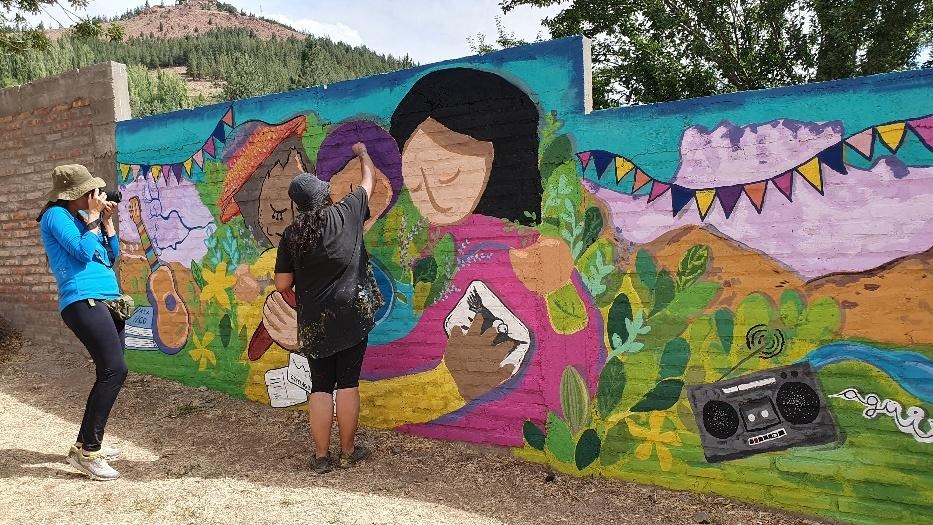
Adriana Arce filming Turca’s final touches in the collective embrace of water in the mural in Huinganco
‘Embracing Water’ had its premiere in the municipal theatre of the village of Huinganco in October, 2023. After the screening, people gathered outside of the building, forming a circle to allow everybody to see each other, horizontally and without a moderator, and took turns in sharing their thoughts based on what they had been seeing. For this particular screening, the audience has mainly come from other assemblies in the Norte Neuquino, and this sharing was also a way of (re)connecting. The pandemic had hit hard on the possibilities of meeting, and many assemblies had felt difficulties in resuming their work afterwards. This screening was therefore an opportunity to meet, share, and learn.
The documentary is about water and its movements within the landscape. After this first encounter with an audience, the documentary travelled with us along the different waterways to other places in and beyond the province: Chos Malal, Las Ovejas, Loncopué, Zapala, Las Coloradas, San Martin de los Andes, Junin de los Andes, and Neuquén as well as Mendoza, Viedma, and Buenos Aires. Since the documentary was made available on youtube, it has travelled beyond our own itineraries. Each of these encounters had their own dynamics which are specific to those places, but shared commonalities in their form and the kinds of reactions and reflections that they generated. The screenings were advertised through the regular communications channels. While these varied between the sites, they always include Whatsapp, often Instagram, and sometimes also other forms of communication like the radio or posters. Audiences ranged between 10 and 100, largely depending on the size of the places we visited, though other factors such as weekdays and weather also mattered. We have convened in different communal spaces such as theaters, schools, churches, and cultural venues.
The final encounter in Viedma and its neighboring city of of Carmen de Patagones held a particular symbolism to the assembly members present. Viedma is located at the mouth of the Río Negro River, which has its origins in the mountains of the Norte Neuquino. Being there made it clear that these assemblies, even though they are located far from each other, are connected by water. And that the struggles connect.
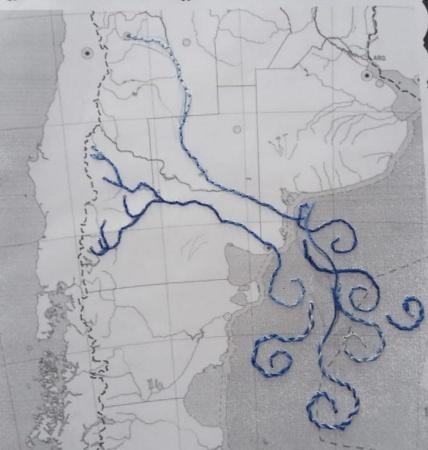
Map of the two main waterways along which the documentary has travelled. Embroidery by Leiza Gagliardo.
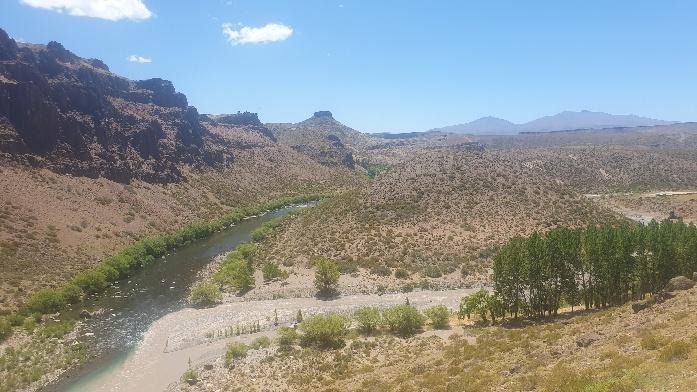
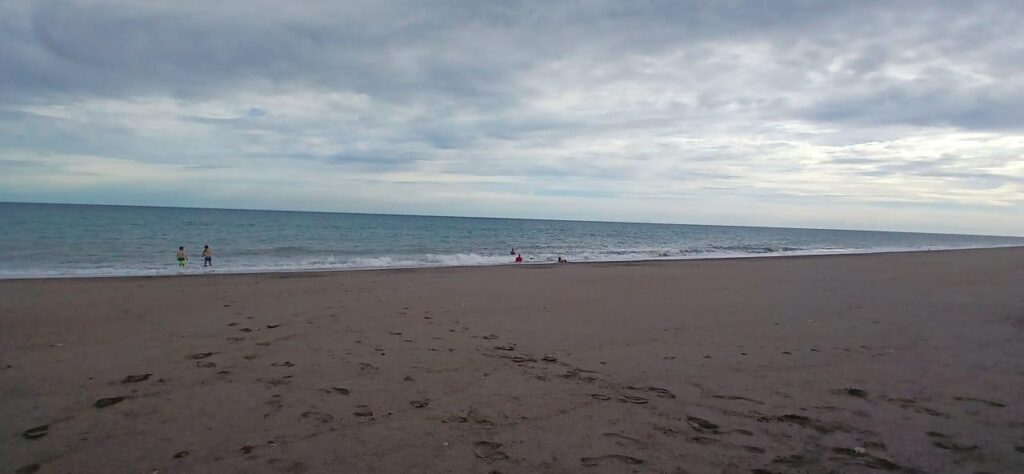
Water that connect: The confluence of the rivers Varvarco y Neuquén in the Norte Neuquino and the Atlantic Ocean near Viedma.
The ability to create connections (vincularse) through the actions of the assembly is a key theme throughout the documentary. It shows in particular how the turn to more artistic forms of expression helped the assembly members establish other relationships to the community. The creation of connections was also key to the encounters over the documentary as it travelled across and beyond the territory of Neuquén. Each screening ended with a round of reflections where the audience present would connect their experiences to what they had just seen. This would of course change from place to place, depending on the composition of the audience – and hence the composition of the local socioenvironmental assembly – and their histories of struggle and collective action.
In Viedma, the screening of the documentary was accompanied by the joint making of a mural. Beyond the symbolism of being at the mouth of the river that connects otherwise separate geographies, the encounter in Viedma was therefore particularly impactful because it was itself an enactment of one of the key messages of the documentary: that the making of murals and other artistic forms serve to connect, to create vinculos, in spaces where everyone can contribute with whatever skill they bring to the collective.
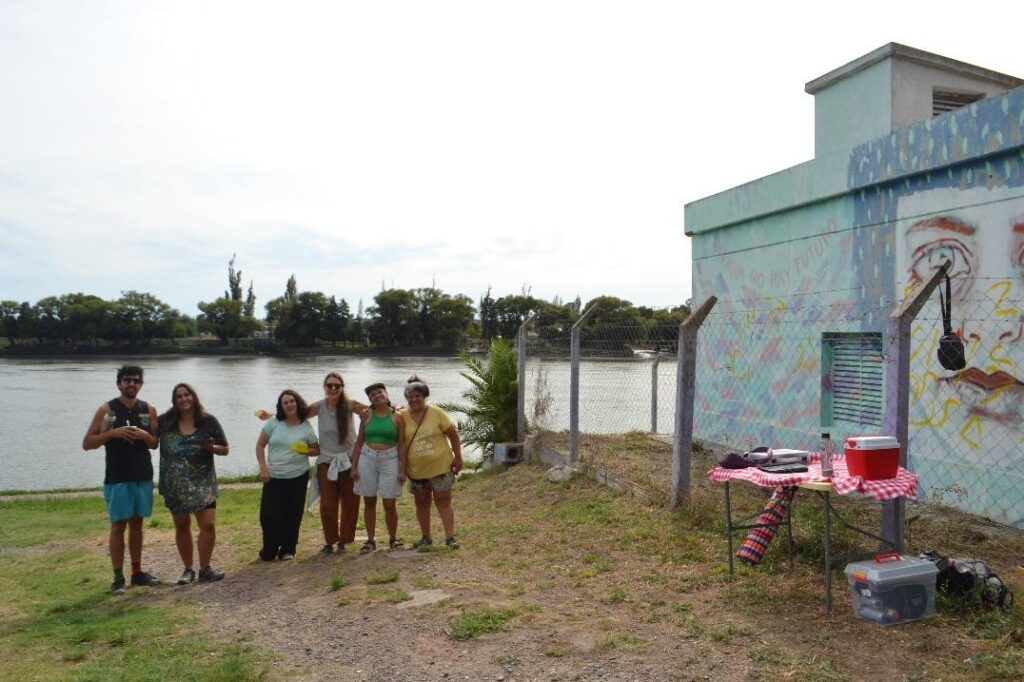
Creating connections in Viedma.
The documentary found a particular audience in educational spaces. Several of the members of the assembly are themselves educators and have used the film for didactical purposes. But also after screenings we have been approached by teachers who have been wanting to use it in their classroom. In these educational encounters, the documentary helps students to see how one might think and do things differently. Not as a template, where they should replicate what has been done in Huinganco, but as a way of breaking with the old habits of thought through art and community work.
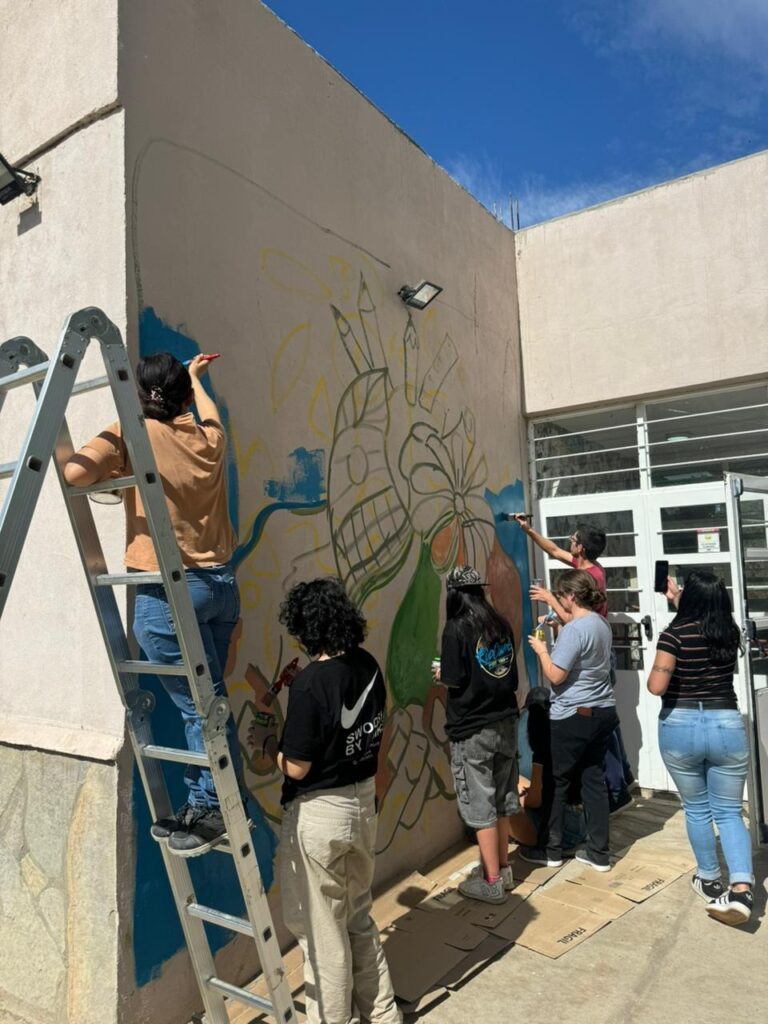
Educational mural in Chos Malal.
While dynamics may have shifted across different locations according to the architecture of the room, the local histories of environmental struggles against a range of issues from mining projects to urban waste management and water quality, and the composition of the audience, including differences in age and education, one theme in particular seem to be important in every single screening: emotions of joy, anger, frustration, gratitude, connectedness. The fundamental logic of the socioenvironmental assemblies is that one participates because one cares. This commitment shone through in the way the audience perceived the narrative, and indeed, in the way that the members of the Huinganco Socioenvironmental Assembly themselves approached these spaces of sharing. Environmental struggles are deeply emotional.
Another keyword in those encounters with the different audiences was hope (esperanza). It is a hope in spite of the obvious deterioration of environmental issues and the current conditions of environmental struggle. People from the audience are well acquainted with the overall issues that many rural and small settlements face as they confront the different varieties of extractivism. In that sense, the documentary adds to the ever expanding catalogue of struggles that people are familiar with and that they also learn through other environmental documentaries. Indeed, for example in Viedma, the screening of Embracing Water was coupled with that of another documentary, which tells the story of the struggle against mining in Las Coloradas. But the narrative and style are different in Embracing Water, and the audience notices how it emphasizes the ways in which the struggle in itself generates meaning and community. In Neuquén, a seventeen-year-old adolescent expressed exactly this kind of hope as she lamented the impacts of fracking in Vaca Muerta and the sense of impotency that that imposes. To her, the documentary showed that other forms of resistance and collective action exist.
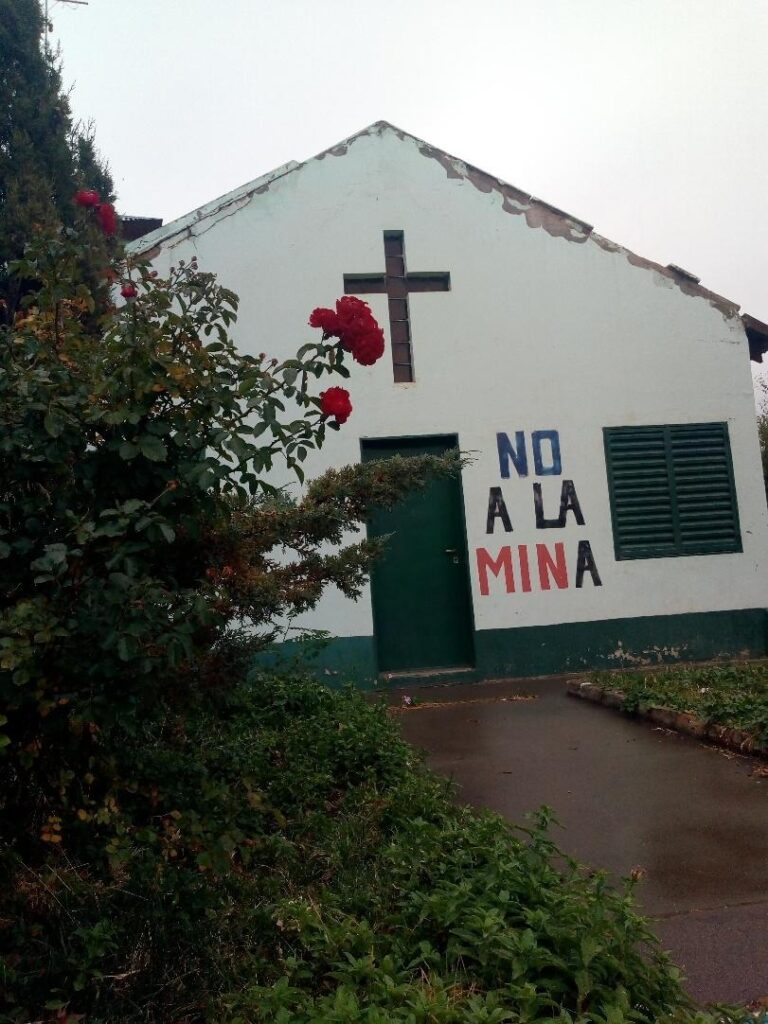
The church in Las Coloradas, a key actor in their struggle.
This is not to argue that all documentaries on environmental struggle should invoke this narrative form. Quite to the contrary: it its is paramount importance that the harm done by extractive industries – often in conjunction with different levels of government – on the territories is denounced. But the way that the audiences reacted to Embracing Water also made it clear that emotions and hope are powerful tools for mobilization and collective action.
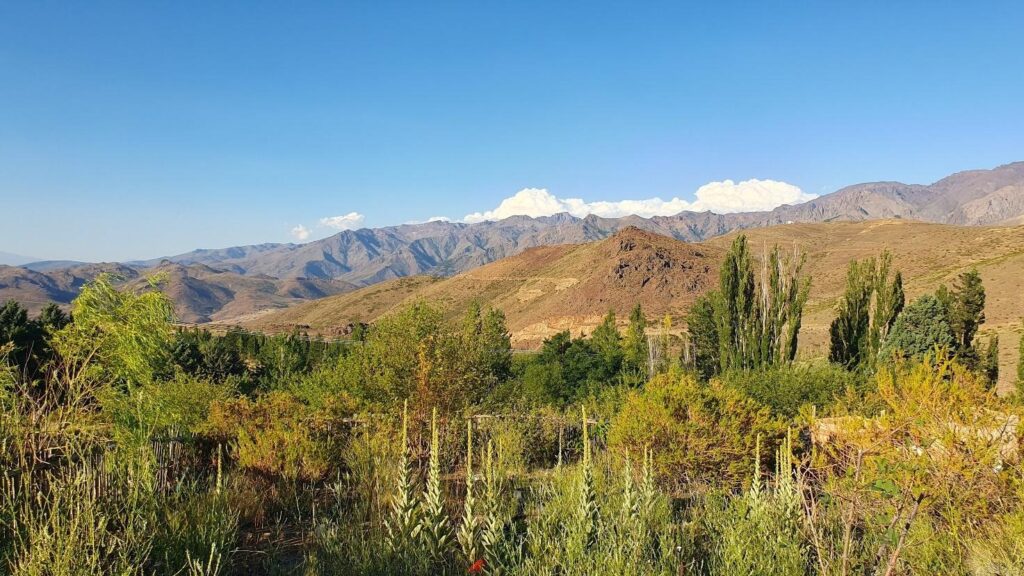
The landscapes of the Norte Neuquino
In the end, we have seen that Arte, Lucha, y Amor reverberated throughout the screenings. Many in the audience were keenly and painfully aware of the current state of affairs. The struggle is necessary, and though it is not always successful in terms of its outcome, the documentary and the ensuing encounters show that this is only part of the story. Environmental struggles are full of meaning and community-making as well. The turn to art is an invocation of a different register and vocabulary of struggle, one that opens up new doors. Embracing Water is both a documentation of that, but also one that in each screening itself contributes to opening up these doors to other ways of thinking and acting collectively.
Bibliograhy
Merlinsky, G., & Serafini, P. (2019). Arte y resistencias al extractivismo en Argentina. Lenguajes para defender y reinventar lo común. Ecología Política, 57, 81–85.
Rasmussen, M. B., & Navarrete, M. (2025). Assembling for water: The prefigurative politics of land futures in Argentina. Antipode.
Rasmussen, M. B., & Navarrete, M. (2024). Hydro-social becomings: Rescaling energy politics in the shadows of Vaca Muerta, Argentina. Journal of Latin American Geography, 23(3), 86-114.
Walter, M., & Wagner, L. (2021). Mining struggles in Argentina. The keys of a successful story of mobilisation. The Extractive Industries and Society, 8(4), 100940.
22 / July / 2026
By: Gerónimo Barrera de la Torre y Carlo Nasisse
22 / July / 2026
By: Adrienne Johnson, Murphy Boksanski, Nicolette Mehdizadeh, Carly Mitchell, Katherine Mottola, Lawrence Philip Tablada Tacto, Isabella Well
22 / July / 2026
By: Emma Johansson
22 / July / 2026
By: Asamblea Socioambiental Huinganco con Adriana Arce, Maximiliano Navarrete y Mattias Borg Rasmussen
22 / July / 2026
By: Aung Htun Lin & Sofie Mortensen