May / 26 / 2026
By: Dr. Laila Sandroni, Dr. Bruno Tarin, and Dr. Erika Larkins
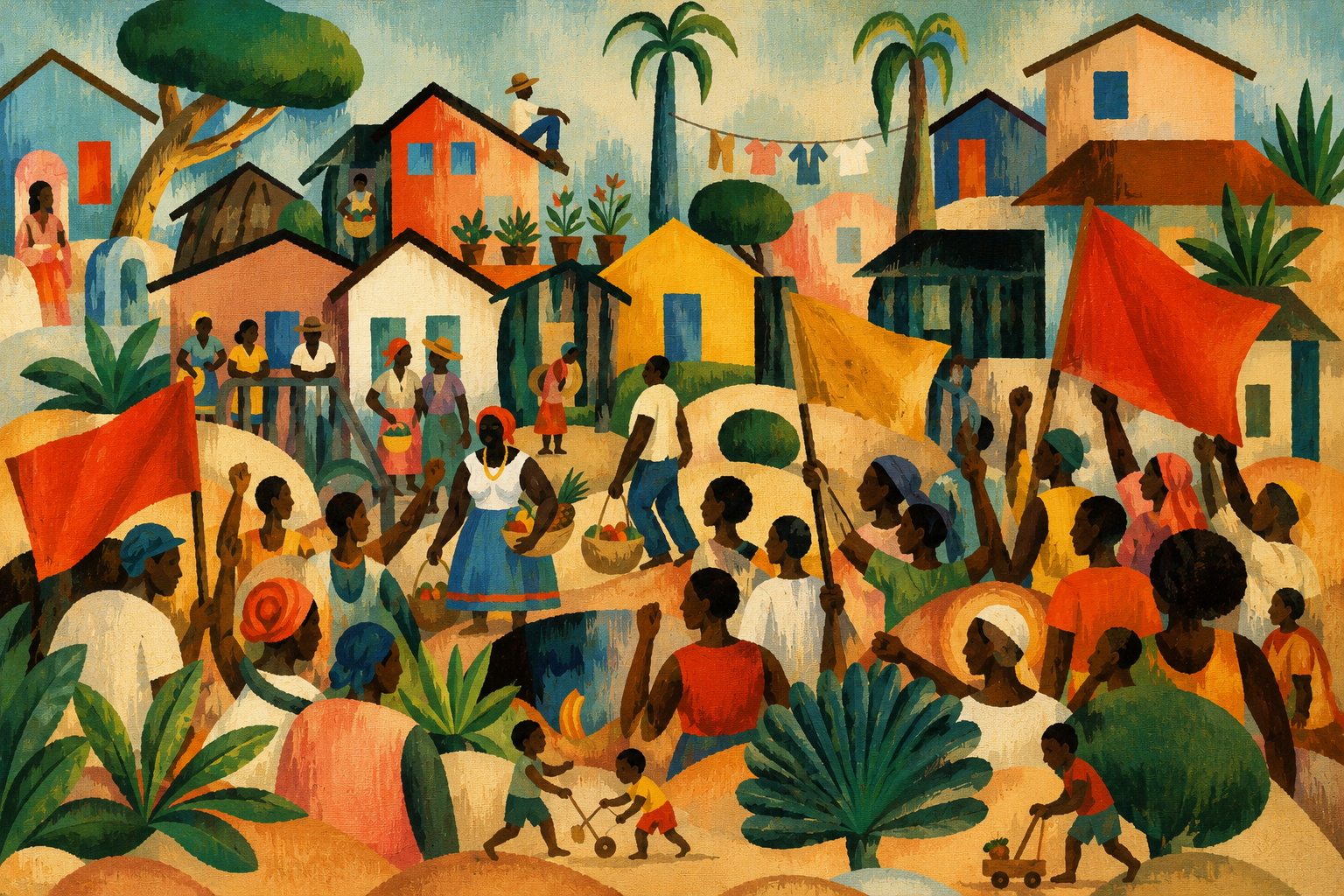
Brazil is Latin America’s largest country, home to over 200 million people and some of the world’s most biodiverse regions. This natural wealth is deeply intertwined with the lives of numerous communities that continue to grapple with the country’s colonial legacy. Today, Brazil’s grassroots movements and local communities still struggle to protect their ancestral territories. Beneath the country’s remarkable cultural and environmental vibrancy lie long-standing inequalities, historical injustices, conflicts over land ownership and access to “natural resources” seen by many of these communities as parts of their social life. Indigenous Peoples and Local Communities (IPLCs) face powerful economic pressures from agribusiness, mining, and other industries, which pose threats to both environmental integrity and human rights.
The materials you are about to see were originally produced as an Open Lecture series coordinated by Dr. Bruno Tarin and co-organized by Dr. Laila Sandroni in 2024–2025, in collaboration with the Behner Stiefel Center for Brazilian Studies at San Diego State University, directed by Dr. Erika Robb Larkins. The series aimed to establish a platform for collaborative learning by integrating academic knowledge, public policy, and the perspectives of Indigenous Peoples and Local Communities. It emphasizes diversity awareness and self-reflection over any single professional monopoly of knowledge, especially by moving beyond academic settings to recognize local people as knowledge producers in their own right, rather than merely subjects of research. Adopting a transdisciplinary approach, the lectures are transcultural spaces where various viewpoints intersect, thereby enriching environmental discourse through the inclusion of insights from Brazilian grassroots movements. Grounded in the principle that environmental justice movements function as “key sources of knowledge and practices” for addressing climate change and biodiversity crises, the series aspires to spark innovative pathways for research and policymaking.
The complete series of lectures can be accessed here. In terms of format, this project involves the publication of a peer-reviewed article in the Journal of Political Ecology (JPE), alongside the release of extended summaries of the eight open lectures on the Grassroots platform.
The authors thank and wish to acknowledge the support of the Behner Stiefel Center for Brazilian Studies, San Diego State University.
26 / May / 2026
By: Dr. Laila Sandroni, Dr. Bruno Tarin, and Dr. Erika Larkins
26 / May / 2026
By: Juliana Tupinambá

27 / May / 2026
By: Dione Torquato

27 / May / 2026
By: Wilson Rocha

29 / May / 2026
By: Caio Dutra and Priscila Tapajowara