
May / 29 / 2026
By: Mônica Borges
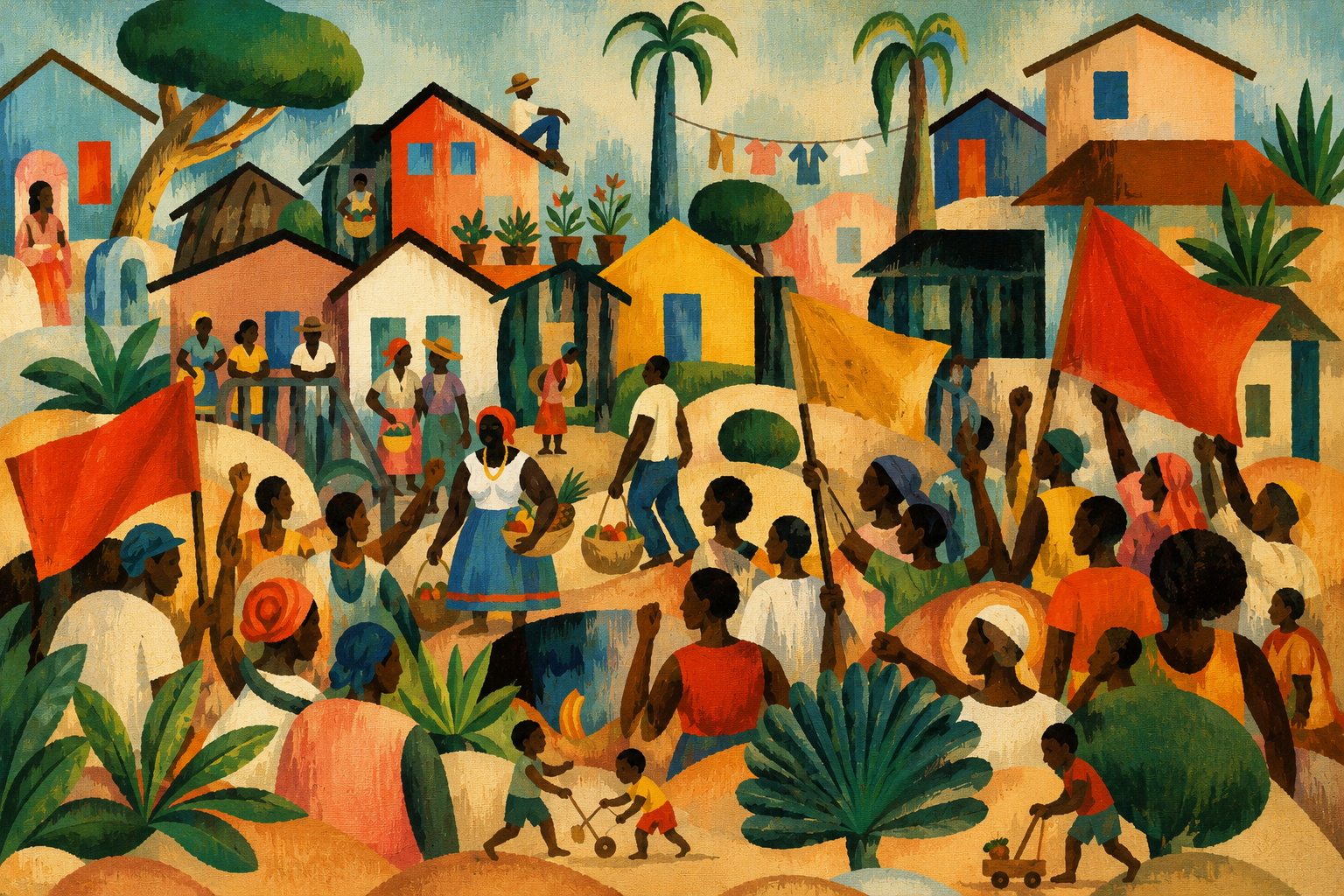
In this lecture, Mônica, a quilombola leader from the community of Itamatatiua in Alcântara, Maranhão, shares a deeply grounded reflection on the interwoven struggles for environmental justice, racial equity, and territorial rights in Brazil. Speaking from her dual role as a grassroots leader and public official, she challenges conventional frameworks by centering the lived experiences and knowledge of quilombola communities. For Mônica, these territories are not only sites of resistance; they are also spaces of care, political imagination, and ecological conservation. Drawing on the work of Malcom Ferdinand, she situates the quilombola struggle within a broader critique of modernity and coloniality, marked by the violent separations between colonizer and colonized, human and nature. Traditional communities, she argues, reject what Ferdinand terms “colonial habitation” through relational practices rooted in ancestry and reciprocity. Rather than reproducing dominant logics of exploitation, quilombos cultivate alternative ways of inhabiting the world. These reflections are reinforced by the legacy of Chico Mendes, whose life connected ecological defense to broader social struggles. Like Mendes, Mônica insists that there is no such thing as a neutral ecology; every environmental question is also a political one. For quilombolas, the struggle for environmental justice is inseparable from centuries of resistance to slavery, land dispossession, and systemic racism. Central to her argument is the idea of territory as a living entity, composed of land, bodies, spirits, and memory. Legal titling, in this sense, is not just a bureaucratic formality; it is an act of recognition and repair. She emphasizes that the best-preserved regions of Brazil’s biomes coincide with traditional territories, where long-standing governance practices have proved more effective than state interventions in preventing environmental degradation. Mônica outlines key strategies developed by quilombola movements: securing land rights, expanding political participation, advocating for transversal public policies, and engaging in international forums. Each of these, she argues, reflects not only resistance but a desire to shape futures rooted in justice and sustainability. Ultimately, Mônica calls for a shift in how we listen and respond to quilombola knowledge and practices, not as peripheral inputs but as central to any serious environmental and political transformation.
Mônica Borges, a quilombola leader from the territory of Itamatatiua in Alcântara, Maranhão, delivers a compelling reflection on the intersections of environmental justice, racial inequality, and territorial resistance in Brazil. Drawing on her lived experience and institutional role within the Brazilian government, Borges offers a grounded analysis of how quilombola communities understand and enact environmental and climate justice. Her lecture bridges political thought, ancestral knowledge, and contemporary policy efforts, advancing a powerful critique of colonial legacies while proposing concrete strategies for transformation.
Borges begins by asserting that environmental and climate justice cannot be understood in isolation from racial injustice. She draws on the work of Malcom Ferdinand, particularly his book A Decolonial Ecology, which theorizes modernity as fractured along two axes: the colonizer/colonized divide and the human/nature divide. These fractures underpin capitalism’s logic of domination, where land and people are simultaneously subjugated. Quilombos, Borges argues, represent resistance to both the social and economic systems that imposed this colonial order. These traditional communities reject what Ferdinand terms “colonial habitation,” that is, the logic of monoculture and overexploitation practices rooted in slavery — by cultivating alternative ways of living, creating, and relating to the environment. For Mônica, Ferdinand’s work resonates with the lived experience of quilombola communities in Brazil, which operate through relational understandings of territory. Borges emphasizes that these communities challenge coloniality through their socio-environmental practices, constituting “spaces of refusal” and invention. She describes quilombos as not only survival strategies but models for other ways of being. She complements this framework with the legacy of Chico Mendes, a rubber tapper, union leader, and environmental activist assassinated in 1988. Mendes promoted forest conservation through sustainable use and grassroots organizing, co-founding the Alliance of Forest Peoples. Borges echoes his insight that there is no neutral ecology: environmental conservation must be embedded in a broader analysis of political and social inequality. She states, then, that for quilombolas, ecology is inseparable from questions of justice and territorial rights.
Borges insists that quilombola identity is deeply rooted in territory, not merely as a geographic space, but as a living entity composed of land, houses, bodies, spirits, and memory. “We are not only talking about land and nature, but we are also talking about the bodies that make up the territory,” she explains. This relational view anchors quilombola understandings of environmental justice: the land is not a resource to be managed but a collective being to be respected and lived with. Legal recognition of quilombola territories was established in the 1988 Brazilian Constitution. Borges notes that this legal framework incorporates both self-definition and anthropological criteria based on collective life practices and ancestral bonds. Yet, despite constitutional guarantees, the titling process remains incomplete and slow, leaving many communities vulnerable. Borges then highlights that the most well-preserved areas of the Amazon and other biomes overlap with traditional territories. These areas, managed according to long-standing community practices, demonstrate lower rates of deforestation and environmental degradation. Traditional territories function as effective conservation zones, not by external imposition, but through the embedded knowledge and responsibility of the communities themselves. Still, the absence of formal land titles undermines communities’ autonomy and environmental stewardship. Without recognition, they face threats from predatory economic ventures, large infrastructure projects, and policy neglect. The issue is not development per se, but the destructive modes imposed without respect for local life systems.
Borges identifies several strategies that quilombola communities in Brazil use to defend their territories and promote environmental justice. The foremost is land titling. She stresses that securing legal recognition is a constitutional right and a prerequisite for any sustainable future: “The titling of territories influences, proportionally and directly, the preservation of these areas.” Another crucial front is political participation. Borges describes how increasing numbers of quilombola leaders have entered electoral politics, running for city councils, mayorships, and national offices. Occupying decision-making spaces is seen as essential for influencing public policy and challenging exclusion. Transversal governance has also been a key practice. Borges details how quilombola advocacy led to the establishment of dedicated offices within several ministries, including the Directorate of Quilombola Territories at INCRA and secretariats within the Ministries of Agrarian Development, Racial Equality, and Health. These institutional structures enable targeted policy design, funding allocation, and improved coordination across government. At the international level, quilombola organizations are becoming more active as well. Borges references the International Coalition of Afro-descendant Peoples and Territories in Latin America and the Caribbean and the Afro-descendant Voices Meeting leading up to COP 30. With COP 30 set to take place in Pará, Brazil, she notes that this global forum has created new opportunities for quilombola leaders to sharpen their political arguments, build alliances, and influence international agendas. The moment has also spurred capacity-building and access to funding, helping communities articulate their demands more effectively and in line with global frameworks.
While cautious in her assessment, Borges acknowledges that the Brazilian government under Lula has taken important steps toward addressing quilombola concerns. Two new national policies reflect this shift: the National Policy for Quilombola Territorial and Environmental Management (PGTAQ) and the Integrated National Health Policy for Quilombola Populations. PGTAQ is particularly significant for its participatory design and focus on community-specific planning, ecosystem protection, and the mapping of policy gaps. The goal is not only to preserve but to enable communities to flourish in their territories. Borges emphasizes that these frameworks must be grounded in traditional knowledge and tailored to each territory’s reality. She argues for the centrality of ancestral perspectives and local governance in crafting effective, dignified public policy. “Communities already carry out environmental and territorial management,” she explains, rooted in a long-standing ethic of care and sustainability. The challenge now is to connect these community practices with state mechanisms, ensuring mutual recognition and support.
In closing, Borges returns to Malcom Ferdinand’s call for a radical departure from the current systems that sustain inequality and ecological destruction. She interprets the call as a demand to rethink politics, economy, and development from the standpoint of traditional knowledge and historical justice. “We need a change,” she insists, “and this change needs to be radical.” For Borges, justice will not be achieved by tinkering at the margins. It requires confronting the roots of colonial modernity and building alternatives anchored in memory, territory, innovation, and collective care. “We have to think outside the box,” she concludes. “And that starts by listening to those who have long protected life and the land.” Quilombola communities, with their centuries-long history of resistance and resilience, offer not only critique but concrete alternatives. Her lecture invites us to recognize quilombola struggles not as peripheral, but central to any serious environmental agenda.
The complete lecture can be accessed below:
26 / May / 2026
By: Dr. Laila Sandroni, Dr. Bruno Tarin, and Dr. Erika Larkins
26 / May / 2026
By: Juliana Tupinambá

27 / May / 2026
By: Dione Torquato

27 / May / 2026
By: Wilson Rocha

29 / May / 2026
By: Caio Dutra and Priscila Tapajowara