
August / 14 / 2026
By: Matthias C. J. De Groof
This article explores the complex interconnections between tantalum extraction, global violence, and environmental degradation, focusing on Congolese mining communities. Tantalum, a conflict mineral integral to modern technologies and aerospace industries, epitomizes the intricate link between resource extraction and geopolitical tensions. We trace the tantalum supply chain from artisanal mines in the Democratic Republic of the Congo, through illicit trade networks, to its usage in consumer electronics, military hardware, and space exploration. By combining diverse perspectives from geology, political ecology, and geo-mythology, we highlight how tantalum’s extraction underpins forms of exploitation that extend beyond local violence to encompass global environmental and economic systems. Through its use in ‘green’ technologies and defense industries, tantalum embodies the paradox of progress in the Anthropocene—simultaneously enabling digital connectivity and perpetuating resource-driven conflict and environmental destruction. This research underscores the urgency of rethinking global supply chains and colonial logics embedded in resource extraction, both on Earth and in outer space.
Keywords: Coltan, Congo, outer pace, media-geology, space colonization.
There are places, such as Kitogota, Mabala, Ngalula, Vukaka, and many others, where the future exists. In some ways, the future exists anywhere, as future. But in these Congolese villages in North-Kivu, South-Kivu, and Ituri, where armed groups such as M23, FDLR, FARDC, and ADF operate around Coltan, Cassiterite, and Gold (IPIS a; IPIS b; Global Witness, 2022), it takes shape as false promises. There, the future is formed through multiple forms of violence: extractivist, social, ecological, economic violence, and especially violence beyond these categories. One of the many but central elements around which these forms of violence coalesce, is tantalum.
Sketching its supply chain, from the mine to planet Mars, will allow us to untangle these multiple forms of violence. Our experimental writing combines extreme close-ups with wide angles to shed light on planetary – and extraplanetary – stakes, and therefore uses sources from different disciplines, including geo-mythology, history, chemistry, media-geology, development studies, anthropology, economy, geology, and political ecology, as well as sources such as reports published by the UN, World Bank, Global Witness, EU, and US military organizations.
What is the intricate relationship between the various uses of tantalum (from telecommunications to the space industry), its geo-mythological dimensions, the experiences surrounding its extraction and exploitation, political and ecological consequences such as conflict and waste, and the involvement of international actors? How do these interconnections offer insights into the nature of political-ecological hegemony? There is no single methodological approach to address these questions; rather, the methods must adapt to the diverse facets and stages in tantalum’s journey. For instance, tracing how the tantalum supply chain contributes to conflict in eastern DRC involves reviewing reports and scientific literature, a method distinct from the more philosophical approach used to take a stance about dominant worldviews in relation to waste. Similarly, investigating tantalum’s role in space exploration relies on secondary sources, whereas exploring its geo-mythological significance required primary research. This latter inquiry included a series of semi-structured interviews with creuseurs, intellectuals, and traditional leaders (chefs coutumiers) such as Fidèle Bafilemba, Pharaon Imote, Willy Yole, Djibu Nsongmwe, Joël Baraka, and Petna Ndaliko Katondolo, with collaborators like Benin Butatunda, Saleh Akilimali, and Olande Byamungu. These conversations explored the local geomythology surrounding tantalum and probed for mythological, cosmological, sacred, and religious functions, values and meanings ascribed to minerals like tantalum in foundational beliefs, cosmologies, and imaginaries present in myths, oral literature, collective memory, and vernacular stories.
The findings from this research were synthesized and presented through a composite, semi-fictional figure named Mr. Doka—a pseudonym used for security reasons, particularly given the ongoing intensification of conflict in eastern Congo. The invocation of Greek mythology, then, serves to illuminate the naming of tantalum and introduces a point of view whose relations to other uses and meanings of tantalum reveal political-ecological hegemony. The connection between contrasting forms of geomythology (Greek and Congolese) functions as a parallax on the phenomenon of extractivism, which in both geomythologies is perceived as hubris and met with punishment.
The other ‘main character’ in the text, Miss Benga, is a tangible figure to represent the smugglers. Smuggling and mining are integral to both Doka’s and Benga’s agency, albeit shaped by different circumstances—deforestation in Doka’s case and land degradation in Benga’s—both of which are deeply enmeshed in a broader geopolitical landscape involving actors such as Rwanda and Congolese rebel groups. Hence, our contribution does not intend to reproduce a North-South dichotomy alongside the victim/perpetrator axe. Rather, we seek to illustrate the layered and dynamic entanglements through which meaning is actively generated around tantalum and the actions that surround its circulation. Together with a short documentary titled Tantalum, this text forms a diptych on how the extractive circuits linking Congolese mining, e-waste, and space colonization expose the paradoxes and violence of techno-futuristic growth in the Anthropocene [9].
Tantalum has several dimensions, ranging from the physical to the mythical. Tantalum is a radioactive heavy metal. Indeed, ‘You can’t eat it’, says Okanda Doka (pseudonym), a miner from Kitogota. ‘Tantalum smells like both richness and death’, he adds. Tantalum is extracted from tantalite, a critical, strategic, and conflict mineral found in coltan along with niobium (formerly called Columbium). Tantalite is the mineral, tantalum is the metal, and coltan is an informal trade name for tantalum concentrates. As a primordial nuclide, Tantalum existed before the birth of this planet.
When the ore is processed to concentrate tantalum, radioactive minerals containing uranium and thorium are also enriched, making tantalum concentrate as a whole radioactive.[1] Listed by the United States Geological Survey in 2022 as one of 50 mineral commodities critical to the U.S. economy and national security, tantalum is regarded as both ‘critical’ and ‘strategic’ by the U.S. Department of Defense (US/Congo Decree 18/042, 24 November 2018; see also Carmody, 2016). Together with niobium, tantalum forms the ore coltan. Niobium takes its name from Niobe, daughter of Tantalus in Greek mythology; her children – Tantalus’s grandchildren – were slain by Apollo, the god who can view planet Earth from above and the name of the first expedition to the moon (Cosgrove, 2001). Before it was renamed Niobium, the metal was called Columbium, after the poetic name of America – Columbia – which in it turn refers to an Italian adventurer who came to symbolize the dawn of colonialism, and the widespread exchange of plants, invasive animals, infectious diseases and ideas between the Americas, Africa and Eurasia, in the form of genocide and slavery (the Columbian Exchange). The Columbia was later also given to a spacecraft (Columbia OV-102).
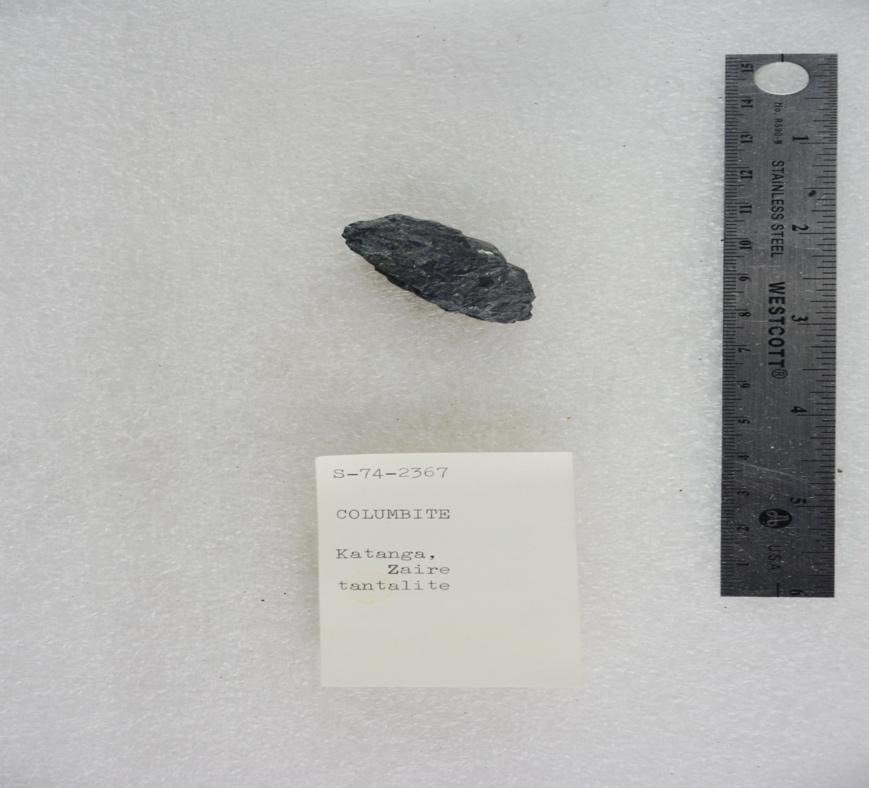
Figure 1: Coltan (Columbite with Tantalite). Photo by Pacific Museum of Earth, University of British Columbia (2019), licensed under CC BY-SA 2.0. Retrieved from https://www.flickr.com/photos/pmeubc/47975489662
The tantalum mined by Doka and his colleagues is used in capacitors for cameras, lenses, game consoles, computers, smartphones, and other digital devices that allow for planetary connectivity and digital capitalism. [Tantalum] came to public attention in the global North in 2000 when supply shortages delayed the Christmas debut of Sony’s new PlayStation 2 on store shelves (Dyer-Witheford, 2015). In 2000, prices for coltan increased tenfold – largely as a result of the launch of the Sony PlayStation 2 games console and new mobile phone handsets – rising to US$365 a pound in the Eastern DRC. (Carmody, 2016). As the British MP Oona King noted,
‘Kids in Congo are being sent down into mines to die so that kids in Europe and America can kill imaginary aliens in their living rooms’ (Carmody, 2016 quoted in Bush and Seeds 2008:1; see also Leonard, 2011).
During the price peak, Sony and Citibank negotiated for coltan directly with the Rwandan-backed Rally for Congolese Democracy (RCD), which was then illegally occupying the Eastern Congo (Montague, 2002). The Congo’s mineral affluence is balanced by a global greed for gadgets in which death becomes a currency (or in more crudely economic terms, an ‘externality’) for the efficient flow of capital to digital distributors and investors (Mantz, 2008:37).
Additional functions of tantalum include weapons, missiles, and spaceships (Tantalum-Niobium International Study Center, 2015a, b; Mackay & Simandl, 2015). ‘The strongest area of growth for tantalum’, writes Tiffany Ma, will be in nickel‐based super alloys for the aeronautics [and aerospace] industry, notably in the production of turbine engines’ (Ma, 2009). Given the militarization of space, tantalum is listed as an important mineral to national strategic defense interests.
‘Amid the resource wars of the 21st century, tantalum […] has become one of the most strategically coveted minerals by Washington’s military industrial complex. It is no longer possible for the US to wage battles abroad without tantalum. [It] has also become a critical component of the quintessential American warrior’s armor: it is among a few dozen metals used to manufacture the US Navy’s elite special forces’ gear’ (Rever, 2023; House Armed Services Committee, 2009).
In redemptory but fallacious promises of ‘green’ and clean energy for the fourth industrial revolution (and of humans as interplanetary species as ‘plan B’), tantalum is considered a cornerstone. In an ironic turn of events, defense industries are therefore boosted in the name of climate action (Soenens, 2023; Petitjean & Verheecke, 2023).
In Kitogota, and many other villages in the far east of the Democratic Republic of Congo, people like Okanda Doka are digging for tantalum in numerous artisanal mines. Okanda Doka is a creuseur, and is positioned at the very beginning of the tantalum supply chain. He is also Mbuti – part of the indigenous community – and longs for the land from which he was expelled (Lonu et al. 2017).
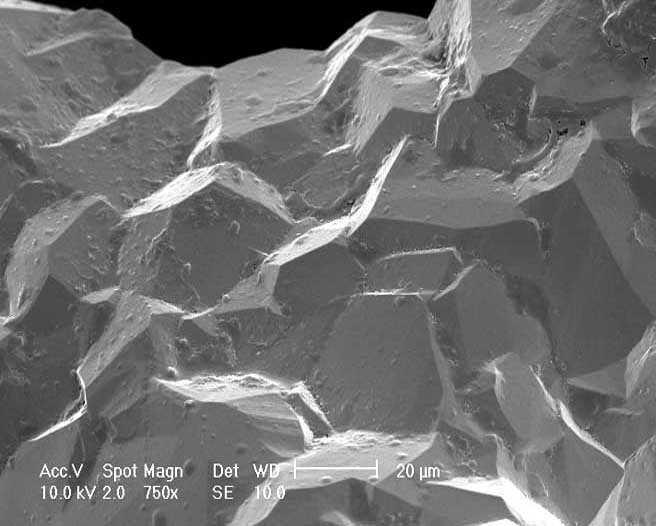
Figure 2a:Scanning electron microscopy showing the inner pores surface. Reprinted from: Maccauro et al. 2009:3 © 2009 Bentham Science Publishers. Reproduced under fair use for academic purposes.
From planet Earth, about 2000 tons of tantalum are mined annually (based on Burt, 2016; Simandl, 2002; Mackay & Simandl, 2014; Papp, 2015; Mackay & Simandl, 2015; Wallwork, 2008; British Geological Survey; US Geological Survey). From Congo, some 800 tons of tantalum are mined annually (conservative estimate based on Taffel, 2021). Quantitatively, this is comparable to Leopold II’s annual ivory exportation (Lenzen et al., 2012, 2013; Arghiri, 1972; Amin; 1978; Smith, 2016; Renton et al., 2007). Congolese tantalum thus accounts for 40% of the world’s tantalum production.[2] The liberalization of the Congolese underground serves to pay off the interest on the debt which Congo incurred to pay off the debt imposed on the Congolese on their independence, although Congo already repaid it 12 times (CADTM).
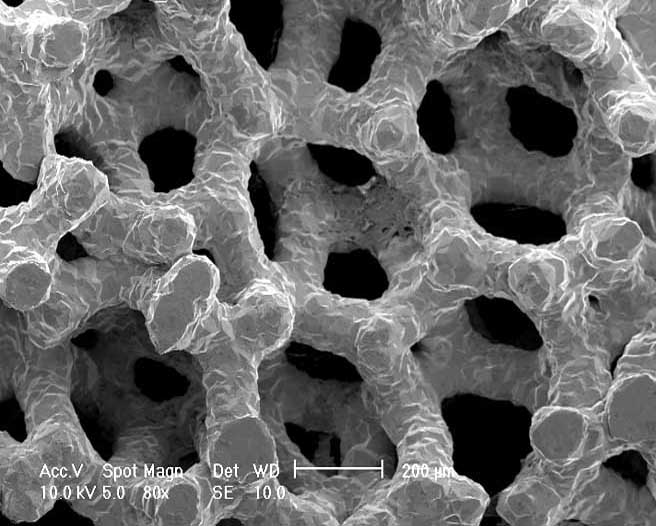
Figure 2b: Scanning electron microscopy showing high porosity of tantalum and the average dimension of pores. Reprinted from: Maccauro et al. 2009, p. 3 © 2009 Bentham Science Publishers. Reproduced under fair use for academic purposes.
The metal tantalum is named after the mortal King Tantalus, as it is capable of enduring torments. In Greek mythology, Tantalus was a King who got rich on mineral wealth. Envious of the gods, he wanted to see if they really knew everything. So he invited them to dinner, and had his own son slaughtered and boiled in a stew. The gods knew and refused to eat. He was punished to forever go hungry – despite being almost within reach of The Tree of Knowledge with juicy fruits – and to forever go thirsty – despite being stood in a pool of the Elixir of Life (Schiller, 1924, p. 14). Finally, the city of Tantalis was submerged by floods in the plains of forgetfulness. This myth gave us the word tantalizing: temptation without satisfaction.
Niobium, the mineral found along with tantalum in coltan, is named after the daughter of Tantalus, Niobé. Niobé’s children – Tantalus’ grandchildren – were killed by Apollo, the god who can view planet Earth from above and the name of the first expedition to the moon (Cosgrove, 2001). Before it was renamed niobium, the metal was called Columbium, after the poetic name of America – Columbia – which in it turn refers to an Italian adventurer who came to symbolize the dawn of colonialism, and the widespread exchange of plants, invasive animals, infectious diseases and ideas between the Americas, Africa, and Eurasia, in the form of genocide and slavery (the Columbian Exchange). The name was also given to a spacecraft, Columbia OV-102.
For the Congolese creuseur Okanda Doka, however, King Tantalus does not appear in his geo-mythology. Tantalum, on the other hand, does. He refers to it as katasumbi (katasumbika), or ‘unbreakable’. According to Doka, metals form an unbreakable archive of knowledge. This knowledge is related to the celestial bodies, composed of the same elements. Of all minerals, tantalum stores knowledge most tenaciously. Access to this knowledge is a blessing for the initiated, but a curse for those who extract it to capitalize on it and who think they have knowledge not intended for them. Since extraction and separation means decay, Doka has no desire to exploit the tantalum.[3]
Doka does also not mine tantalum with the intention of buying a smartphone, flying to Mars or contributing to the war. As a matter of fact, he is forced to do so by the rebel group that controls the Coltan mine.[4] His daughter has no desire to exploit the tantalum either.[5] It goes without saying that they themselves are being mined.
Tantalum is everywhere, from your pocket to outer space, from the DNA of nano-tech to superalloys in space rockets. It links the infinitesimally small with the immeasurably big.
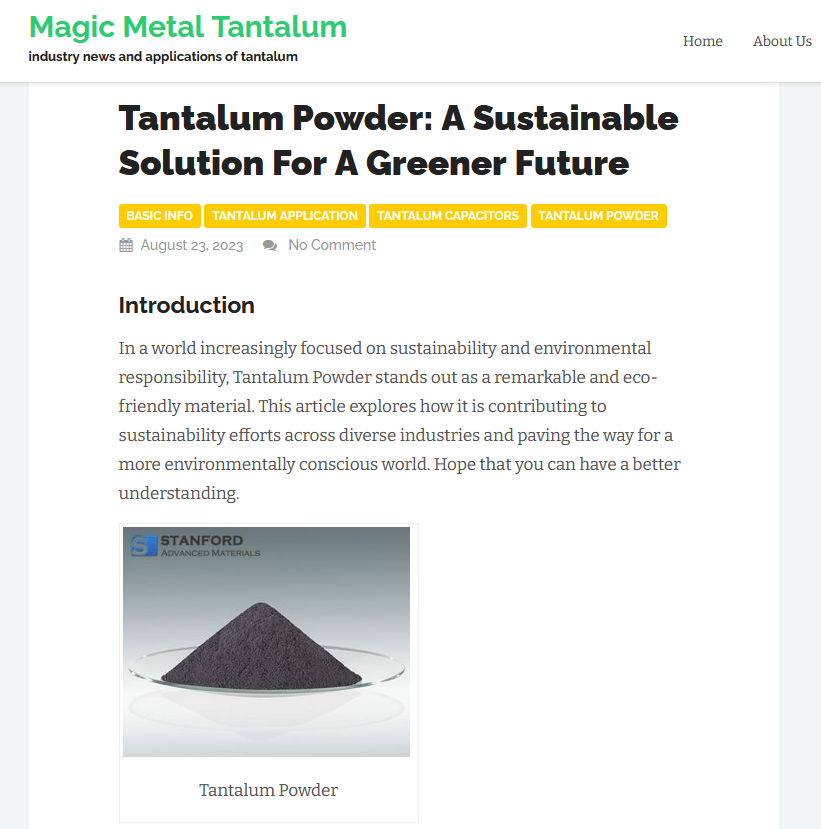
Figure 3: Screenshot from strongtantalum.com. Tantalum powder: A sustainable solution for a greener future. Reproduced under fair use for academic purposes.
The cutting edge of technological advance has shifted from extensive to intensive expansion, from outward expansion into the cosmos and into the infinitesimally small scales of microcircuitry, genes, and nanotechnology. And in a symbolic indicator of the fact that humanity is entering the Anthropocene far more decisively than the Space Age, many major America space facilities, located on coasts and islands, will soon be under water as sea level rises due to climate change (Deudney, 2020, p. 21).
Since the amount our blue planet offers is limited, tantalum is monetized as ‘blue gold’. ‘The demand for tantalum in 2035 will be 4 times that of the 2013’ (Hartman, 2016, p. 49). Since 1990, tantalum demand has increased by an average of 6% per year (Ma, 2009). For their transition to a so-called green energy, Europeans estimate an annual off-take of 500 tons of tantalum, 99% coming from outside Europe (European Commission, 2020; European Commission, n.d.).
On behalf of his rebel group, Okanda Doka sells 23kg of tantalum to Oto Benga (pseudonym). This 23kg represents a value of US$970 on the market (SSNano; Trade-metal; Leonard, 2011; Simandl, 2002; Mackay & Simandl, 2014; Papp, 2015; UN Statistics, 2019; Attero Blog, 2012; Globalissues, 2001).
Of what Doka sells to the smuggler, he only keeps US$3 (Fuchs 2014a, p. 178-9 in Dyer-Witheford, 2015:106; Geenen et al., 2021). The smuggler goes to Congo Fair Mining (Muderwa, 2021; Adam 2021; Congomines, 2021; Global Witness, 2022) to have the tantalum tagged as a clean with an ICGLR certificate, and in order to circumvent the embargo on conflict minerals and child labor (Global Witness, 2022, p. 5-10). Since the control body for the conflict-free labels is financed by levies on tantalum exports, this laundering is facile through the ITSCI system, set up to comply with the ‘Due Diligence Guidance for Responsible Supply Chains of Minerals from Conflict-Affected and High-Risk Areas’ (Global Witness, 2022, p. 5,7).
Benga smuggles tantalum because she can no longer farm and she can no longer farm because her land was contaminated by the mining of tantalum. Coltan mining leads to landslides and damages agriculture (Tegera, Mikolo and Johnson, 2002; Nest and Grignon, 2006; Carmody, 2016).
In Numbi in Kalehe the massive destruction of former grazing land is catastrophic. Soil which has been used for unplanned prospection and artisanal coltan mining is no longer usable for agriculture. Entire hills and valleys have been turned into giant craters, turning the landscape of the region into an expanse of naked earth, at the bottom of which flow rivers and streams which were diverted for the requirements of coltan mining (Tegera 2001, p. 20).
More generally, UN Environment’s Global Resource Outlook estimates that mining is responsible for 90% of biodiversity loss and water stress. (For human and environmental impacts, see Dominish, 2019; Marx, 2019; see also UN’s Resourcepanel).
Through the use of ‘dummy mines’ (Global Witness, 2022, p. 58), the laundromat resells the tantalum through Rwanda to companies in Luxemburg, Dubai, and Hong Kong (DRC Ministry of Mines, export statistics for South Kivu, 2020, 2021; Werner, 2003; Ma, 2009; Ruffini, 2008; Ewing, 2008; Zogbi, 2008).The Rwandan government is fully aware that the country’s production figures are inflated by smuggling, multiple industry sources told Global Witness. Neither the government nor the ITSCI programme publishes the sort of mine-level production data which might be able to prove otherwise. While ITSCI has taken action against some minor incidents of mineral smuggling, large companies that have exported the bulk of the smuggled minerals were reportedly left alone. The most important of these companies was Minerals Supply Africa (MSA), for some years the largest exporter of 3T minerals from Rwanda: one source estimates that between 2011 and 2017 only a tiny share of its exports from Rwanda was actually mined there. Swiss businessman Chris Huber (currently under criminal investigation for war crimes in DRC) has also allegedly profited from using the ITSCI scheme to launder smuggled minerals through at least three companies (Trial International, 2019). Smuggling from DRC to Rwanda has decreased since around 2014, at which time the ITSCI programme began to expand its presence in DRC. Nevertheless, smuggling of 3T minerals has continued to pay much better than mining’ (Global Witness, 2022, p. 7). A former mine operator in Rwanda told Global Witness that buying smuggled minerals is cheaper than mining minerals (Global Witness, 2022, p. 49).
Some Dubai companies are fronts created by Swiss businessmen who also happen to own the control body for minerals, ITSCI (Global Witness, 2022, p. 36-9; Tantalum-Niobium International Study Center, 2020, p. 8,10; ITSCI, 2016).
The border between Rwanda and Congo is particularly porous for tantalum. Approximately 252,45 tons a year of tantalum goes from Congo to Rwanda as powder (Global Witness, 2022, p. 6,48,52; Schütte, 2020). A small part of that amount goes back from Rwanda to Congo as part of the technology in weapons. The profit that Rwanda makes by reselling the laundered tantalum from, amongst others, FDLR, is used to fight this same group, by the rebel group M23. Annie Leonard (2011) estimates that the occupying Rwandan army made roughly US$500 million from Congolese coltan between April 2007 and October 2008. Other sources describe a self-financing war economy centered on mineral exploitation, generating up to US$20 million per month at its peak and sustaining the Rwandan army (Pöyhönen & Simola, 2007; Ma, 2009; see also Hara, 2002). Income produced by the Rwandan military’s “Congo Desk” was kept separate from the national budget, yet far exceeded it, and is believed to have supplemented military expenditures (UN Panel of Experts, 2001§33,130; 2002§70–71, §75–76; Global Witness, 2022, p. 53). See also Montague (2002, p. 106 and Carmody, 2016).
The tantalum mined by Doka and others contributes US$348 million each year to financing conflicts (called Africa’s World War) which have 16.500 annual casualties . This amounts to a calculated US$21,000 per victim. The International Rescue Committee (IRC) estimated that between 1998 and 2008 alone, over 5 million people died as a result of violence, disease, and malnutrition in the DRC. Other estimates put the number even higher (see Usanov, 2013; Parens, 2022; Worldwithoutgenocide, 2023; Global Conflict Tracker; UN’s International Organization for Migration (IOM); UN Office for the Coordination of Humanitarian Affairs).
The company in Dubai sells tantalum to Japan, Israel, the EU, the U.S. and China (Ma 2009), for a total of $175.5 million.[6] China is the largest importer of tantalum, and the largest exporter of capacitors.
Doka’s tantalum ends up in my smartphone, which will be considered waste after a certain amount of time. Humans produce about 64 tons of solid waste per second (Kaza, 2018; World Bank, n.d.), including 1.7 tons of e-waste (Ewastemonitor; Globalewaste). My discarded smartphone will contribute 0.00000000024 % to this (Atlas.d-waste). Although a European produces 14 times more e-waste than a Ghanaian (Global e-Waste Monitor 2020, p. 22), 5 times more e-waste per person arrives in Ghana (and Agbogbloshie in particular) than the average Ghanaian uses (UN Environment Programme, in Minter, 2016; Shaw, 2019). A Ghanaian therefore undergoes disproportionate effects of the ruination caused by humanity’s overconsumption and waste-colonialism (Liboiron, 2021). In return, Ghanaians may resell tantalum and other toxic ores (Global e-Waste Monitor 2020, p. 58) extracted from e-waste (such as my smartphone) for profit. The e-waste recyclers – children included (Doeland, 2023) – receive more than just profit from their labor. They also get dioxins that become carcinogenic in placentas and breast milk (the breast milk of women working in e-waste recycling has more than twice the levels of carcinogenic dioxins, and their placentas have nearly triple the levels compared to women in a control group (Jing, 2014), and other diseases such as tumors and pneumoconiosis that seriously impair their proper functioning. Tantalum is radioactive and is an experimental tumorigentic or tumor causing substance, also causing pneumoconiosis and skin damage (Kerwien, 1996; Dotson, 2018; Global e-Waste Monitor 2020, p. 62-7).
Because of these diseases, and so that Europeans do not have to bear the consequences of their overconsumption (Parsons, 2023), Europe’s environmental impact is outsourced, and electronic waste is taken to certain places, quite far away, such as Ghana, where the recycling of tantalum is good for 1% (Barume, 2016; Schutte, 2021; Ueberschaar, 2017) of tantalum-imports (Papp, 2015; Mackay, 2015). Although there exist very useful machines for recycling, artisanal recycling at US$5 a day is cheaper than the purchase and maintenance of these machines. The piece of tantalum – extracted by Mr. Doka in the mine of FDLR, exchanged for money with the smuggler for a company in Dubai, via Rwanda’s laundromat and whose value was set on the internet – is now available to the children of Agbogbloshie to be recycled and resold. These children have to work on average 315 times longer than the CEO of the Dubai company, to get the same amount,[7] and 7,200,000,000 times longer than the CEO of SpaceX, and therefore longer than the age of our solar system. The money that these children earn is not enough to treat their diseases. Certainly not if they need skull plates made with tantalum, suture clips to close up wounds, made with tantalum; or gauze to help bind abdominal muscles, made with tantalum (Lasley, 2021).
Humans distinguish themselves from other mammals by the technological capacity to alter the environment. A certain sub-category of humans (mostly those within historic modes of capital accumulation) conceive this capacity to adapt its habitat as the plundering of it. Paradoxically, it is this ability to transform the environment in such a way that it ruins its own habitat, that allows these type of human being to believe in the idea of infinite growth, and tend to believe that other humans and non-humans are there for its benefit. This is inspired to them by fictional entities, such as God, money, or property. Children in Agbogbloshie have no ability to ruin our environment. They are already in the ruins.
Like King Tantalus, the eponymous tantalum can withstand great torment – meaning that it can withstand huge temperature changes, is excellent at storing and releasing energy (Lasley, 2021) and is sufficiently resistant to be used in spaceships and in weapons. Moreover, it combines both functions perfectly. On Outer space militarization (Marx, 2021), the following headlines:
Musk on new mission to deliver US military weapons by space (Evans, 2020).
The US military and Elon Musk are planning a 7,500-mph rocket that can deliver weapons anywhere in the world in an hour (Duffy, 2020).
In the Guardian (Durkin, 2018), we read about the Space Operations Force, ‘an elite group of war fighters specializing in the domain of space’.
Some persons of great power like Musk or Bezos accumulate so much profit thanks to their ruination of our planet that they colonize space to distract us from this ruin, and present this to us as the solution to escape from the planet that does not grow in line with their idea of infinite growth (Noor, 2021; Marx, 2019, 2020a,b, 2021; Kern, 2021; Johnstone, 2021 a,b; Dvorsky, 2019; Cornish, 2019; Durani, 2019; Musk 2017; Stirone, 2021 a,b; Phillips, 2021).
Because Doka’s tantalum can endure torments, it is used in rocket engines and missiles and thus for space colonization, from Apollo to SpaceX (Inshewat 2020:1,7).
Although this form of colonization does not involve the subjugation of species – which is why it might be seen as an offensive term erasing experiences of peoples under colonialism since ‘the Moon and Mars are rocks, not human beings’ (Phillips, 2021) – the mentality that underpins colonization of space repeats white-supremacist rhetorics of saviorism in combination with extractivism, militarization, and a very colonial language of conquests and frontiers. The space race uses colonial exploration as paradigm and prototype for ‘progress’ (See also the Just Space Alliance; Levine, 2015; French Military; De Groof, 2020; Marx, 2020b)
In sum, space colonization is the exploratory and extractive extraterrestrial colonization that justifies mining elements such as tantalum, which has a relative abundance of around 10-2 in the solar system.[8] In sum, space colonization is a small step for mankind that led to nowhere (McNeill, 2008:15-6). Thanks to an unequalled view in weightlessness (Marx, 2020a), space-colonizers become ironically enchanted with the planet. The only thing they are colonizing is our future. Like Tantalus, they sacrifice their children to aspire at being God, but, not being able to drink or eat amidst abundance, it is the Congolese who bear the brunt of the punishment. Tantalum, mined by Mr. Doka, can now serve to forget the future that could have been in favor of the future that is not.
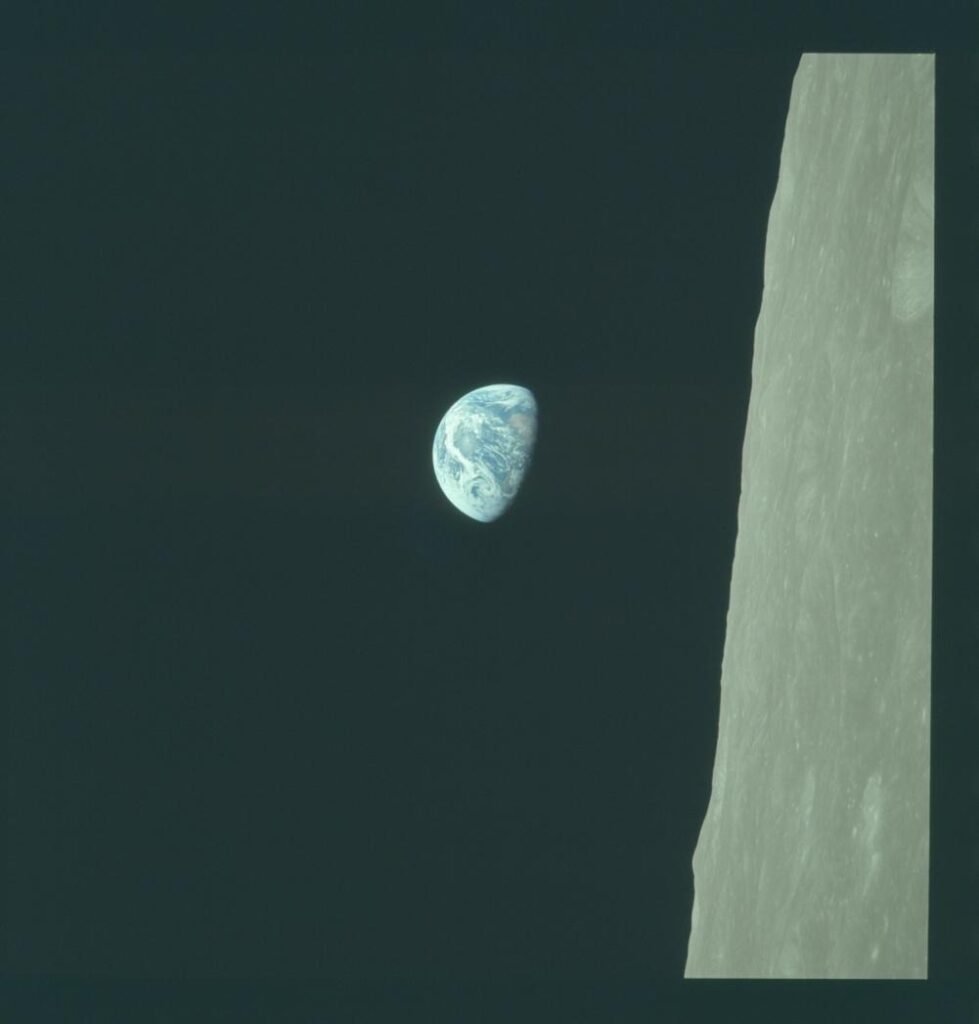
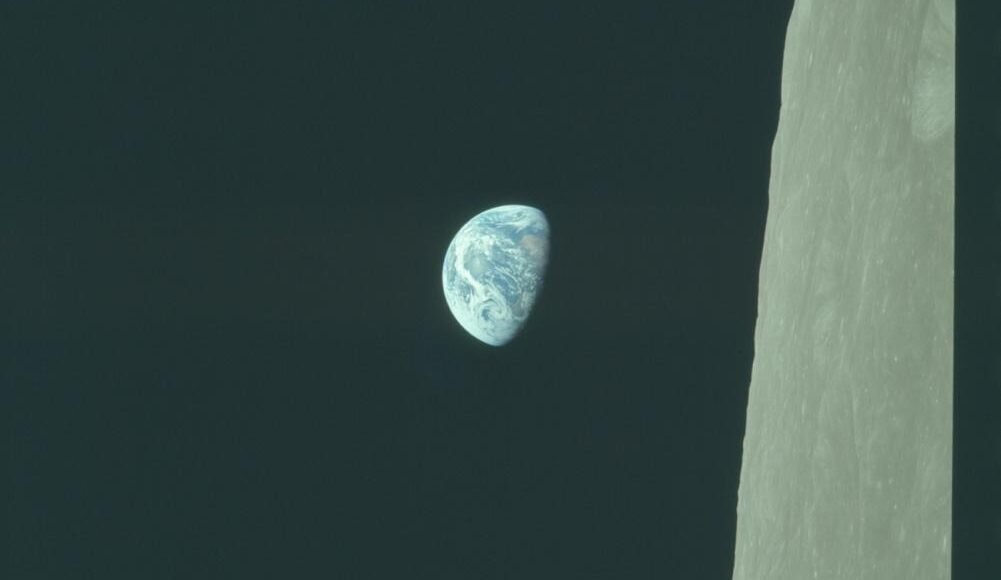
Figure 4: Earthrise, taken by astronaut William Anders during the Apollo 8 mission on December 24, 1968. Image courtesy of NASA. NASA Image and Video Library. Public domain.
This article explores how the connections between tantalum—extracted from Congolese mines—e-waste, and the high-tech colonization of space, reveal the inherent unsustainability of growth-driven ideologies. It examines the paradox whereby tantalum extraction enables the viability of a techno-futuristic military industrial complex, yet such extraction is premised upon the evacuation of the futures of those mining the ore in the Congo. In doing so, the article argues that the Anthropocene in Africa is an evacuative process that links crude mineral extraction to high-tech space explorations that seek to create terraformations beyond the planetary limits of mother Earth. This paradox—of an economic product that promises us a future and its extraction that deprives us of one—is not new, but is part of a longer tradition. Indeed, the extraction of rubber during the Second Industrial Revolution—used as a tangible manifestation of and leverage for a belief in progress, while causing ecological, epistemic, and genocidal destruction—is, in essence, not fundamentally different from the extraction of tantalum and other critical minerals for the Fourth Industrial Revolution during the ‘NewSpace’ era. Though the scale has shifted, and space colonization reveals how the snake bites its own tail, the cycle of extractivism, productivism, consumerism, and waste persists. The critical difference, however, is that unlike the colonial Plantationocene, today’s visions of ‘terraforming’ the Moon and Mars—as well as space colonization as a whole—is an illusionary project (Deudney, 2020; Nesvold, 2023; Prescod-Weinstein et al, 2020; Régnault & Saint-Martin, 2024). Tantalum illustrates with grim irony the absurdity of the abovementioned cycle that, in order to present itself as still conceivable, has to point towards dead planets.
Thanks to: Petna Ndaliko Katondolo, Sarah Aimê, Julia Nicolescu, Monica De Bock, Jasper Flikschuh, Benin Butatunda Mzee Aleshkov, Joost Prins, Sebastien Demeffe, Thomas Walravens, Laura Matikaenen, Natasha Ikoli, Innocent Raha, René Assoumani, Bahati Erickey Xy93, Jobson Katondolo, Libu Manga, Virgilio Vasconcelos, Djino Lumumba, Fidèle Bafilemba, Pharaon Imotep, Willy Yole, Djibu Nsongmwe, Joël Baraka, Saleh Akilimali, Olande Byamungu, Patricia Pisters. In memory of Byamana Sebazungu Kabasele. This work was supported by the Marie Skłodowska-Curie Postdoctoral Fellowship (MSCA-IF-EF-ST) under Grant 101061438.
Adam, J. P. (2021, May 17). DRC wants back in driver’s seat on coltan. Africaintelligence. https://www.africaintelligence.com/eastern-africa-and-the-horn/2021/05/17/drc-wants-back-in-driver-s-seat-on-coltan,109666369-ge0
Ailton Krenak (2020). Ideas to postpone the end of the World. House of Anansi Press Ltd.
Amin, S. (1978). Unequal development: An essay on the social formations of peripheral capitalism (B. Pearce, Trans.). The Harvester Press.
Arghiri, Emmanuel, (1972). Unequal exchange: A study of the imperialism of trade. Monthly Review Press.
Attero Blog (2012), E-waste recycling: Coltan – The new blood diamond. Retrieved from https://web.archive.org/web/20150109231354/https:/attero.in/blogs/e-waste-recycling-coltan-the-new-blood-diamond/
Barume, B., Naeher, U., Ruppen, D., & Schütte, P. (2016). Conflict minerals (3TG): Mining production, applications, and recycling. Current Opinion in Green and Sustainable Chemistry, 1, 9. 10.1016/j.cogsc.2016.07.004
Bokamba, E. G., & Bokamba, E. D. (2022). Mining data study. Center for Research on the Congo-Kinshasa.
Bouamama, S. (2022, December 15). Zoveelste bloedbad in Congo: Het Westen wast de handen in onschuld. Dewereldmorgen. https://www.dewereldmorgen.be/artikel/2022/12/15/zoveelste-bloedbad-in-congo-het-westen-wast-de-handen-in-onschuld/
Burt, G. (2016). Much ado about tantalum. Again. Retrieved from https://tanb.org/images/Much%20ado%20about%20tantalum(1).pdf
Bush, C., & Seeds, J. (2008, April 19). Apocalypse found: Coltan, cell phones and crisis in the Congo. Common Dreams. http://eco-cell.com/news/details/apocalypse-found
CADTM. (2021). Généalogie de la dette en République démocratique du Congo. https://www.cadtm.org/Genealogie-de-la-dette-en-Republique-democratique-du-Congo
Carmody, P. R. (2016). The new scramble for Africa. Polity Press.
Congomines (2001). https://congomines.org/reports/2146-contrat-de-jv-entre-sakima-et-la-societe-cdmc-sarl [HB1]
Cornish, G. (2019, July 22). How imperialism shaped the race to the moon. The Washington Post. https://www.washingtonpost.com/outlook/2019/07/22/how-imperialism-shaped-race-moon/
Cosgrove, D. E. (2001). Apollo’s eye: A cartographic genealogy of the earth in the western imagination. Johns Hopkins University Press.
De Groof, M. (2020). Columbus on a spaceship, or: Decolonising the anthropocene. Viewfinder Magazine, 114.
Deudney, D. (2022). Dark skies: Space expansionism, planetary geopolitics, and the ends of humanity. Oxford University Press.
Doeland, L. (2023). Apocalypsofie: Over recycling, groene groei en andere gevaarlijke fantasieën. Ten Have.
Dominish, E., Florin, N., & Teske, S. (2019). Responsible minerals sourcing for renewable energy. Report prepared for Earthworks by the Institute for Sustainable Futures, University of Technology Sydney. https://earthworks.org/wp-content/uploads/2019/04/Responsible-minerals-sourcing-for-renewable-energy-MCEC_UTS_Earthworks-Report.pdf
Dotson, D. J. (2018, May 10). How to identify platinum in ore deposits. Sciencing. https://sciencing.com/identify-platinum-ore-deposits-8750860.html
Duffy, K. (2020, October). The US military and Elon Musk are planning a 7,500-mph rocket that can deliver weapons anywhere in the world in an hour. Business Insider. https://www.businessinsider.com/musks-spacex-partners-us-military-to-deliver-weapons-by-rockets-2020-10?r=US&IR=T
Durani, H. (2019). Is spaceflight colonialism? The Nation. https://www.thenation.com/article/world/apollo-space-lunar-rockets-colonialism/
Durkin, E. (2018, August 10). Space force: All you need to know about Trump’s bold new interstellar plan. The Guardian. https://www.theguardian.com/us-news/2018/aug/10/space-force-everything-you-need-to-know
Dvorsky, G. (2019). Humans will never colonize Mars. Gizmodo. https://gizmodo.com/humans-will-never-colonize-mars-1836316222
Dyer-Witheford, N. (2015). Cyber-proletariat: Global labour in the digital vortex. Between the Lines.
Eliade, M. (1978). The forge and the crucible: The origins and structure of alchemy. University of Chicago Press.
European Commission. (n.d.). Critical raw materials. https://single-market-economy.ec.europa.eu/sectors/raw-materials/areas-specific-interest/critical-raw-materials_nl
European Commission. (2020). Critical raw materials resilience: Charting a path towards greater security and sustainability.https:eurlex.europa.eulegalcontentENTXTHTMLuri=CELEX:52020DC0474&from=EN
Evans, M. (2020). Musk on new mission to deliver US military weapons by space. The Times. https://www.thetimes.co.uk/article/musk-rocket-would-go-from-us-to-the-middle-east-in-an-hour-xfznrdg9f
Ewing, J. (2008, November 17). Congo fighting revives tainted phone fears. Business Week.
Fuchs, C. (2014). Digital labour and Karl Marx. Routledge.
Geenen, S., Stoop, N., & Verpoorten, M. (2021). How much do artisanal miners earn? An inquiry among Congolese gold miners. Resources Policy, 70, 101893. https://doi.org/10.1016/j.resourpol.2020.101893
Global Issues (2001). Guns, money and cell phones, Retrieved from https://www.globalissues.org/article/442/guns-money-and-cell-phones
Global Witness (2022). The ITSCI laundromat: How a due diligence scheme appears to launder conflict minerals. https://gw.hacdn.io/media/documents/The_ITSCI_Laundromat_-_April_2022.pdf
Hara, F. (2002). Hollow peace hopes in shattered Congo. International Crisis Group. https://www.crisisgroup.org/africa/central-africa/democratic-republic-congo/hollow-peace-hopes-shattered-congo
Hartmann, D., Sheng, Y. X., Casanovas, S., Garcia, R. B., & Moya, M. G. (2016). Report on current and future needs of selected refractory metals in EU. MSP-REFRAM. https://prometia.eu/wp-content/uploads/2020/12/MSP-REFRAM-D1.1-Report_on_current_and_future_needs.pdf
Harvey, D. (2004). The ‘new’ imperialism: Accumulation by dispossession. The Socialist Register, 63-87. https://socialistregister.com/index.php/srv/article/view/5811/2707
Heusch, L. D. (1983). La capture sacrificielle du pangolin en Afrique centrale. Systèmes de pensée en Afrique Noire, 131-147. https://doi.org/10.4000/span.541
House Armed Services Committee (2009). Hearing on proposed reconfiguration of the national defense stockpile. https://www.govinfo.gov/content/pkg/CHRG-111hhrg52723/pdf/CHRG-111hhrg52723.pdf
Inshewat, Y. (2020). ECM and EDM of tantalum and niobium alloys for use in the space industry. Tel Aviv University. https://www.researchgate.net/publication/344157706_ECM_and_EDM_of_Tantalum_and_Niobium_alloys_for_use_in_the_space_industry
IPIS (n.d. a). Carte de l’exploitation minière artisanale dans l’Est de la RD Congo. https://www.ipisresearch.be/mapping/webmapping/drcongo/v6/?#-2.5752976279537734/28.44283103942871/10.905262753062958/4/1/
IPIS (n.d. b). Artisanal mining in DR Congo – IPIS Open Data Dashboard. https://ipisresearch-dashboard.shinyapps.io/open_data_app/
ITSCI (2016). Roland Chavasse joins iTSCi Governance Committee. Retrieved from https://itsci.org/2016/02/24/roland-chavasse-joins-itsci-governance-committee/
Jin, J. (2014). E-waste & the regulatory commons: A proposal for the decentralization of international environmental regulation. Brooklyn Journal of International Law, 39(3). Available at: https://brooklynworks.brooklaw.edu/bjil/vol39/iss3/9
Johnstone, C. (2021a). Space colonization and the myth of separateness. Notes from the Edge of the Narrative Matrix. https://www.caitlinjohnst.one/p/space-colonization-and-the-myth-of
Johnstone, C. (2021b). Space colonization is a capitalist perception management op. Notes from the Edge of the Narrative Matrix. https://www.caitlinjohnst.one/p/space-colonization-is-a-capitalist
Kaza, S., Yao, L. C., Bhada-Tata, P., & Van Woerden, F. (2018). What a waste 2.0: A global snapshot of solid waste management to 2050. World Bank. http://hdl.handle.net/10986/30317
Kern, S. (2021, July 7). No, billionaires won’t ‘escape’ to space while the world burns. Salon. https://www.salon.com/2021/07/07/no-billionaires-wont-escape-to-space-while-the-world-burns/
Kerwien, S. C. (1996). Toxicity of tungsten, molybdenum, and tantalum and the environmental and occupational laws associated with their manufacture, use, and disposal. U.S. Army Armament Research, Development, and Engineering Center. https://apps.dtic.mil/sti/tr/pdf/ADA310298.pdf
Lamb, C. (2019, March 9). Congo’s miners dying in hell tunnels to power your mobile. The Times. https://www.thetimes.co.uk/article/congos-miners-dying-in-hell-tunnels-to-power-your-mobile-dtcw285ht
Lasley, S. (2021, September 16). Critical twin metals take differing paths. Mining News. https://www.miningnewsnorth.com/story/2021/09/16/critical-minerals-alliances/critical-twin-metals-take-differing-paths/6983
Lenzen, M., Kanemoto, K., Moran, D., & Geschke, A. (2012). Mapping the structure of the world economy. Environmental Science & Technology, 46(15), 8374–8381. 10.1021/es300171x
Lenzen, M., Moran, D., Kanemoto, K., & Geschke, A. (2013). Building eora: A global multi-region input-output database at high country and sector resolution. Economic Systems Research, 25(1), 20–49. https://doi.org/10.1080/09535314.2013.769938
Leonard, A. (2011). The story of stuff: How our obsession with stuff is trashing the planet, our communities, and our health. Free Press.
Levine, N. (2015, March). Democratize the universe. Jacobin. https://jacobin.com/2015/03/space-industry-extraction-levine
Liboiron, M. (2021). Pollution is colonialism. Duke University Press.
Lonu, M.-B. D., Gehrin, M., Cordonier, M.-C., Moke, M. I., & Wa Bassa, S. M. (2017). Le régime foncier congolais: Du contact avec la civilisation occidentale à la veille de la loi n°73-021 du 20 juillet 1973 dite foncière. European Scientific Journal, 13(10), 211. https://doi.org/10.19044/esj.2017.v13n10p211
Ma, T. (2009, June 22). China and Congo’s coltan connection. Project 2049 Institute. https://project2049.net/2009/06/22/china-and-congos-coltan-connection/
Maccauro, G., Iommetti, P., Muratori, F., Raffaelli, L., Manicone, P., & Fabbriciani, C. (2009). An Overview about Biomedical Applications of Micron and Nano Size Tantalum. Recent Patents on Biotechnology, 3(3), 157–165. 10.2174/187220809789389153
Mackay, D. A. R., & Simandl, G. J. (2014). Geology, market and supply chain of niobium and tantalum: A review. Mineralium Deposita, 49, 1025–1047. https://doi.org/10.1007/s00126-013-0502-2
Mackay, D. A. R., & Simandl, G. J. (2015). Niobium and tantalum: Geology, markets, and supply chains. In G. J. Simandl & M. Neetz (Eds.), Symposium on Strategic and Critical Materials Proceedings, November 13–14, 2015, Victoria, British Columbia (pp. 13–22). British Columbia Geological Survey Paper 2015-3. https://cmscontent.nrs.gov.bc.ca/geoscience/publicationcatalogue/Paper/BCGS_P2015-03-03_Mackay.pdf
Marx, P. (2019, July). We don’t need space colonies, and we definitely don’t need Jeff Bezos. Jacobin. https://jacobin.com/2019/07/space-colonies-jeff-bezos-blue-origin
Marx, P. (2019, June 14). The electric vehicle revolution will be dirty and unequal. Radical Urbanist. https://medium.com/radical-urbanist/the-electric-vehicle-revolution-will-be-dirty-and-unequal-674d9184ee6f
Marx, P. (2020a, January). Elon Musk is planning for climate apocalypse. Jacobin. https://jacobin.com/2020/01/elon-musk-climate-apocalypse-tesla-spacex
Marx, P. (2020b, December). Billionaire space colonialism is a dead end. Tribune Magazine. https://tribunemag.co.uk/2020/12/billionaire-space-colonialism-is-a-dead-end-for-humanity
Marx, P. (2021, July). Leave the billionaires in space. Jacobin. https://jacobin.com/2021/07/billionaires-space-richard-branson-jeff-bezos-elon-musk
McNeill, J. R. (2008). Gigantic follies? Human exploration and the space age in long-term historical perspective. In S. J. Dick (Ed.), Remembering the space age (pp. 15–16). NASA.
Minter, A. (2016, July). The burning truth behind an e-waste dump in Africa. Smithsonian Magazine. https://www.smithsonianmag.com/science-nature/burning-truth-behind-e-waste-dump-africa-180957597/
Montague, D. (2002). Stolen goods: Coltan and conflict in the Democratic Republic of Congo. SAIS Review, 22(1), 103–118. 10.1353/sais.2002.0016
Muderwa, A. (2021, September 27). Exploitation industrielle du coltan en RDC: Congo Fair Mining sur les rails. 7sur7.cd. https://7sur7.cd/2021/09/27/exploitation-industrielle-du-coltan-en-rdc-congo-fair-mining-sur-les-rails
Musk, E. (2017). Making humans a multi-planetary species. New Space, 5(2), 46–61. https://doi.org/10.1089/space.2017.29009.emu
Nest, M. W., & Grignon, F. (2006). The Democratic Republic of Congo: Economic dimensions of war and peace. Lynne Rienner Publishers.
Nesvold, E. (2023). Off-earth: Ethical questions and quandaries for living in outer space. MA: MIT Press.
Noor, D. (2021, July). Space tourism is a waste. Gizmodo. https://gizmodo.com/space-tourism-is-a-waste-1847285820
Papp, J. F. (2015). Tantalum. In U.S. Geological Survey, Mineral commodity summaries 2013 (pp. 162–163).
Parens, R. (2022, September). Conflict in eastern Congo: A spark away from a regional conflagration. Foreign Policy Research Institute. https://www.fpri.org/article/2022/09/conflict-in-eastern-congo-a-spark-away-from-a-regional-conflagration/
Parsons, L. (2023). Carbon colonialism: How rich countries export climate breakdown. Manchester University Press.
Petitjean, O., & Verheecke, L. (2023, November). Blood on the green deal. Corporate Europe Observatory and Observatoire des Multinationales. https://corporateeurope.org/en/2023/11/blood-green-deal
Phillips, L. (2021, May). We don’t need Elon Musk to explore the solar system. Jacobin. https://jacobin.com/2021/05/elon-musk-space-exploration-mars-colonization
Povinelli, E. A. (2016). Geontologies: A requiem to late liberalism. Duke University Press.
Pöyhönen, P., & Simola, E. (2007, December). Connecting component dividing communities. FinnWatch. https://www.germanwatch.org/sites/default/files/press_release/2271.pdf
Prescod-Weinstein, C., Walkowicz, L. M., Tuttle, S., Nord, B., & Neilson, H. R. (2020). Reframing astronomical research through an anticolonial lens: For TMT and beyond. https://doi.org/10.48550/arXiv.2001.00674
Radley, B. (2023). The three-stage process through which African resource sovereignty was ceded to foreign mining corporations. Review of African Political Economy. https://doi.org/10.1080/03056244.2023.1946956
Régnault, I., & Saint-Martin, A. (2024). Une histoire de la conquête spatiale: Des fusées nazies aux astrocapitalistes du new space. La Fabrique éditions.
Renton, D., Seddon, D., & Zeilig, L. (2007). The Congo: Plunder and resistance. Zed Books.
Rever, J. (2023, September 25). Rwanda is the ‘Wild West’ and should be removed from the mineral supply chain. Canadian Dimension. https://canadiandimension.com/articles/view/rwanda-is-the-wild-west-and-should-be-removed-from-the-mineral-supply-chain
Riederer, R. (2018, July). Narcissists in space. Jacobin. https://jacobin.com/2018/07/space-barons-review-elon-musk-bezos-thai-cave
Ruffini, A. (2008). Africa remains key to future tantalum supply. Engineering and Mining Journal, 68–72.
S. A. Congo’s tragedy: The war the world forgot. (2006, May 5). The Independent. https://www.independent.co.uk/news/world/africa/congo-s-tragedy-the-war-the-world-forgot-6101835.html
Savage, L. (2021, July). The billionaire space race is the ultimate symbol of capitalist decadence. Jacobin. https://jacobin.com/2021/07/billionaire-space-race-richard-branson-bezos-musk
Schiller, F. S. C. (1924). Tantalus or the future of man. Longmans, Green & Co.
Schutte, P. (2021). Sustainability report on tantalum. BGR.
Schutte, P. (2021). Tantalum: Sustainability information. Bundesanstalt für Geowissenschaften und Rohstoffe (BGR).
Schütte, P., & Naeher, U. (2020). Tantalum supply from artisanal and small-scale mining: A mineral economic evaluation of coltan production and trade dynamics in Africa’s Great Lakes region. Resources Policy, 69, 101896. 10.1016/j.resourpol.2020.101896
Shaw, N. (2019). For Ghana e-waste recyclers, a safer option amid toxic fumes. Associated Press. https://apnews.com/general-news-f9a0d071d1d646edb2b53fd22fd8548c
Simandl, G. J. (2002). Tantalum market and resources: An overview. In Geological Field Work 2001 (pp. 313–318). British Columbia Ministry of Energy and Mines, Geological Survey of British Columbia. https://cmscontent.nrs.gov.bc.ca/geoscience/publicationcatalogue/Paper/BCGS_P2002-01-22_Simandl.pdf
Smith, J. (2016). Imperialism in the twenty-first century: Globalization, super-exploitation, and capitalism’s final crisis. NYU Press.
Smith, J. H. (2011). TANTALUS in the digital age: Coltan ore, temporal dispossession, and ‘movement’ in the Eastern Democratic Republic of the Congo. American Ethnologist, 38(1), 17–35. 10.1111/j.1548-1425.2010.01289.x
Smith, J. H. (2015). ‘May it never end’: Price wars, networks, and temporality in the ‘3 Ts’ mining trade of the Eastern DR Congo. HAU: Journal of Ethnographic Theory, 5(1), 1–34. https://doi.org/10.14318/hau5.1.002
Smith, J. H. (2021). The eyes of the world: Mining the digital age in the Eastern DR Congo. University of Chicago Press.
Soenens, D. (2023, November 7). Wapenlobby drukt stempel op Europese energietransitie. APACHE. https://apache.be/2023/11/07/wapenlobby-drukt-stempel-op-europese-energietransitie?check_logged_in=1
Stirone, S. (2021a, February). Mars is a hellhole: Colonizing the red planet is a ridiculous way to help humanity. The Atlantic. https://www.theatlantic.com/ideas/archive/2021/02/mars-is-no-earth/618133/
Stirone, S. (2021b, July). Space billionaires, please read the room: Jeff Bezos and Richard Branson are choosing a terrible time to leave Earth. The Atlantic. https://www.theatlantic.com/science/archive/2021/07/space-billionaires-jeff-bezos-richard-branson/619383/
SSNano (n.d.). Tantalum nanoparticles prices. Retrieved from https://www.ssnano.com/inc/sdetail/tantalum_nanoparticles__nanopowder___ta__99_7__60_80_nm_/2091
Taffel, S. (2021). Digital media ecologies: Entanglements of content, code, and hardware. Bloomsbury Academic.
Tantalum-Niobium International Study Center. (2015a, 2015b).
Tantalum-Niobium International Study Center. (2020). Annual report.
Taussig, M. (2009). My cocaine museum. University of Chicago Press.
Taussig, M. T. (2010). The devil and commodity fetishism in South America. University of North Carolina Press
Tegera, A. (2001). The coltan phenomenon: How a rare mineral has changed the life of the population of war-torn North Kivu province in the East of the Democratic Republic of Congo. Pole Institute. http://www.kongo-kinshasa.de/dokumente/ngo/polinst_coltan.pdf
Tegera, A., Mikolo, S., & Johnson, D. (2002). The coltan phenomenon: How a rare mineral has changed the life of the population of war-torn North Kivu province in the East of the Democratic Republic of Congo. Pole Institute. http://www.kongo-kinshasa.de/dokumente/ngo/polinst_coltan.pdf
Trade-metal (n.d.). Coltan (tantalite) ore CIF/FOB from Congo. Retrieved from https://trade-metal.com/coltan-tantalite-ore-cif-fob-from-congo-p76518.html
Trial International (2019). Pillage: Ongoing investigation following the denunciation of a Swiss businessman for war crimes in the DRC. Retrieved from https://trialinternational.org/latest-post/pillage-swiss-businessman-under-criminal-investigation-for-war-crimes-in-the-drc/
Tricontinental: Institute for Social Research, the Centre Culturel Andrée Blouin, the Centre for Research on the Congo-Kinshasa, & Likambo Ya Mabele. (2024, June). The Congolese fight for their own wealth (Dossier No. 77). https://thetricontinental.org/dossier-77-the-congolese-fight-for-their-own-wealth/
Ueberschaar, M., Jalalpoor, D. D., Korf, N., & Rotter, V. S. (2017). Potentials and barriers for tantalum recovery from waste electric and electronic equipment. Journal of Industrial Ecology, 21(3), 700–714. 10.1111/jiec.12577
UN Group of Experts on the Democratic Republic of the Congo. (2023, December 15). Letter from the Group of Experts on the Democratic Republic of the Congo addressed to the President of the Security Council (S/2023/990). https://digitallibrary.un.org/record/4032027?v=pdf#files
UN Group of Experts. (2021). Final report of the group of experts on the Democratic Republic of the Congo (S/2021/560_E, Annex 42). https://docs.un.org/en/S/2021/560
UN Panel of Experts. (2001). Report of the Panel of Experts on the Illegal Exploitation of Natural Resources and Other Forms of Wealth of the Democratic Republic of the Congo (Report S/2001/357, paras. 33, 130).https://www.securitycouncilreport.org/atf/cf/%7B65BFCF9B-6D27-4E9C-8CD3-CF6E4FF96FF9%7D/DRC%20S%202001%20357.pdf
UN Panel of Experts. (2002). Final report of the Panel of Experts on the Illegal Exploitation of Natural Resources and Other Forms of Wealth of the Democratic Republic of the Congo (Report S/2002/1146, paras.75–76)
UN Resource Panel (n.d.). https://www.resourcepanel.org/reports/global-resources-outlook
UN Security Council. (2002, October 16). Final report of the Panel of Experts on the Illegal Exploitation of Natural Resources and Other Forms of Wealth of DR Congo (S/2002/1146). https://www.securitycouncilreport.org/atf/cf/%7B65BFCF9B-6D27-4E9C-8CD3-CF6E4FF96FF9%7D/DRC%20S%202002%201146.pdf
Usanov, A., de Ridder, M., Auping, W., Lingemann, S., Espinoza, L. T., Ericsson, M., Farooki, M., Sievers, H., & Liedtke, M. (2013). Coltan mining in the DRC report: Coltan, Congo & conflict report. Hague Centre for Strategic Studies. https://hcss.nl/wp-content/uploads/2013/06/HCSS_21_05_13_Coltan_Congo_Conflict_web.pdf
Wallwork, P. (2008, September). Challenges facing the tantalum industry. In Minor metals and rare earths conference.
Werner, K. (2003). Das neue Schwarzbuch Markenfirmen [The New Black Book of Brand Companies].
World Bank (n.d.). Trends in solid waste management. Retrieved from https://datatopics.worldbank.org/what-a-waste/trends_in_solid_waste_management.html
Yusoff, K. (2018). A billion black Anthropocenes or none. University of Minnesota Press.
Zogbi, D. M. (2008). Tantalum: Global market outlook: 2008–2013. Paumanok Publications Inc.
[1] See Philip Schütte, personal mail, 20/02/2022
[2] Other sources estimate the Congolese proportion of the world’s tantalum output to be higher, such as 44% (Schutte 2021:5); 50% (Global Witness, 2022:10; Barume et al., 2016, p. 9; Schütte et al., 2020, p. 1); 64% (Tantalum-Niobium International Study Center, 2015a; Mackay and Simandl 2015); and 80% (Leonard, 2011). Eyamba et al., 2024, estimate it to 35%. See also the Niobium and Tantalum Statistics and Information By the National Minerals Information Center and Indexmundi.
[3] In fact, he objects to the commodification and privatization of land. ‘These dynamics recall Marx’s description of primitive accumulation, or Harvey’s (2004, p. 74) reconceptualization of this as a continuous process of accumulation by dispossession, involving ‘the commodification and privatization of land and the forceful expulsion of peasant populations, conversion of various forms of property rights into exclusive private property rights, [and] suppression of rights to the commons’. Forcibly displaced and removed from the best deposits, African miners are restricted to working in less productive areas’ (Radley, 2023).
[4] It could be FDLR, M23, or any armed group, such as the Wazalendu or others. See UN Group 2023, 2024, 2025.
[5] On forced labor, see Global Witness, 2022, p. 28; on child labor, see Global Witness, 2022, p. 28-9 and Lamb 2019.
[6] This estimate is based on NNMS account of Ningxia Orient Tantalum Industry Co. Ltd (OTIC), whose total assets are estimated to be over 1.6 billion yuan (US$234 million) and tantalum products accounts for almost three quarters of its sales.
[7] See: www.michaelpage.com.hk; fr.glassdoor.be; and www.payscale.com.
[8] See Asteroidminingcorporation (https://asteroidminingcorporation.co.uk/japans-hayabusa-2-mission-and-what-is-means-for-asteroid-mining); Mindat (mindat.org/loc-7798.html); The Institute for Rare Earth Elements and Strategic Metals (institut-seltene-erden.de/rare-earth-mining-on-the-moon-is-possible/); Planetary Resources; and Spaceangels (spaceangels.com).
[9] This article forms a diptych with the short documentary Tantalum, 16’22”, 2026, produced by: Cobra Films (Belgium), Yole!Africa (DRCongo), Nime (Brasil). Awards: Prix du meilleur court métrage documentaire (Fickin. DRCongo), BIM Award for best film on environmental themes (BREF – International Film Festival), Winner of the Belgian Shorts (Afrika FilmFestival – Leuven).
25 / August / 2026
By: Ngaka Mosiane, Phathutshedzo Eugene Ratshiedana, and Wendy Tsoriyo
25 / August / 2026
By: Jackson Tamunosaki Jack
25 / August / 2026
By: Tholithemba Lorenzo Ndaba, Madoda Mkhobeni, and William Matlala
14 / August / 2026
By: Timothy Elikem Harvor and Alena Thiel
14 / August / 2026
By: Matthias C. J. De Groof